FCW System Failed on Honda: Comprehensive Causes, Diagnostics, and Fixes
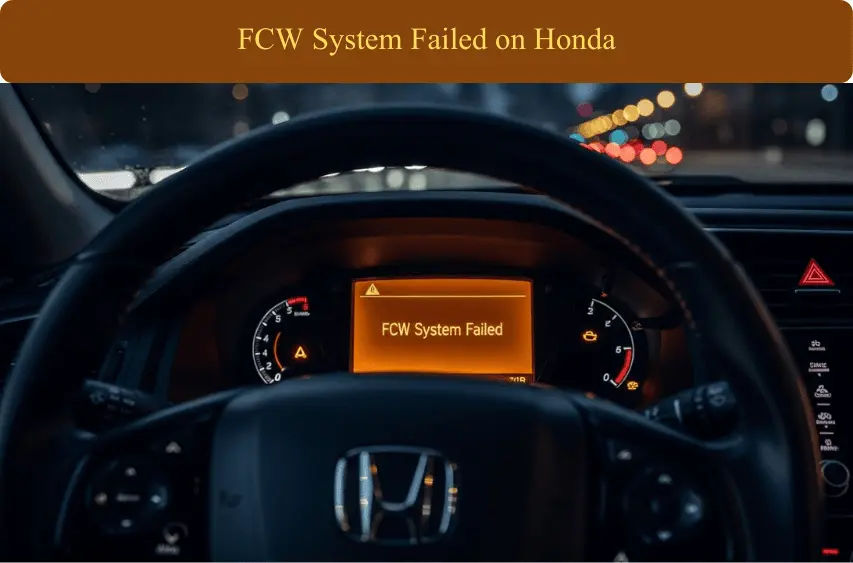
You are driving down the highway, cruise control on, enjoying a smooth ride. Suddenly, an orange warning light pops up on your dashboard with a message that makes your heart skip a beat: “FCW System Failed.”
It is a stressful moment for any driver. You immediately wonder if your brakes are about to fail or if it is safe to keep driving. The good news is that while this warning requires attention, it rarely means your car is undriveable. The Forward Collision Warning (FCW) system is a passive safety feature, and when it fails, your car’s core mechanics—steering, braking, and accelerating—usually remain fully functional.
However, ignoring the light isn’t the answer. This system is your second pair of eyes on the road. In this guide, we will break down exactly why this happens, how to troubleshoot it yourself, and when you need to call a professional. As Honda continues to refine its safety tech in upcoming models like the 2026 Honda Accord facelift, understanding these current systems is essential for every owner.
What is the Honda Forward Collision Warning (FCW) System?
To fix the problem, you first need to understand what is actually breaking. The FCW system is part of the broader Honda Sensing suite, designed to prevent rear-end collisions. It acts as a digital co-pilot that constantly scans the road ahead of you.
The Technology Behind the Eyes
The system doesn’t rely on magic; it relies on two specific pieces of hardware working in harmony:
- Millimeter-Wave Radar: This is typically located behind the Honda emblem on your front grille. It measures the distance and speed of the car in front of you.
- Monocular Camera: You can usually see this lens mounted at the top of your windshield, right near the rearview mirror. It identifies shapes, such as vehicles and pedestrians.
Passive vs. Active Safety
It is crucial to distinguish between FCW and the Collision Mitigation Braking System (CMBS).
- FCW is Passive: Its only job is to warn you. It uses visual lights, beeping sounds, or steering wheel vibrations to say, “Hey, wake up! You’re getting too close.”
- CMBS is Active: If you ignore the FCW warnings and a crash is imminent, the CMBS steps in to automatically apply the brakes.
When you see the “FCW System Failed” error, it often means the car has disabled both systems to prevent them from acting on bad data. This is why getting it fixed is a priority.
Why It Matters
According to safety data from the IIHS, forward collision warning systems reduce rear-end crashes by 27%. That is a significant safety net to lose just because of a dirty sensor or a loose wire.
Common Signs and Symptoms of FCW Malfunction
The car usually tells you exactly when it is unhappy, but the symptoms can vary depending on the specific model and the severity of the issue.
Dashboard Alerts
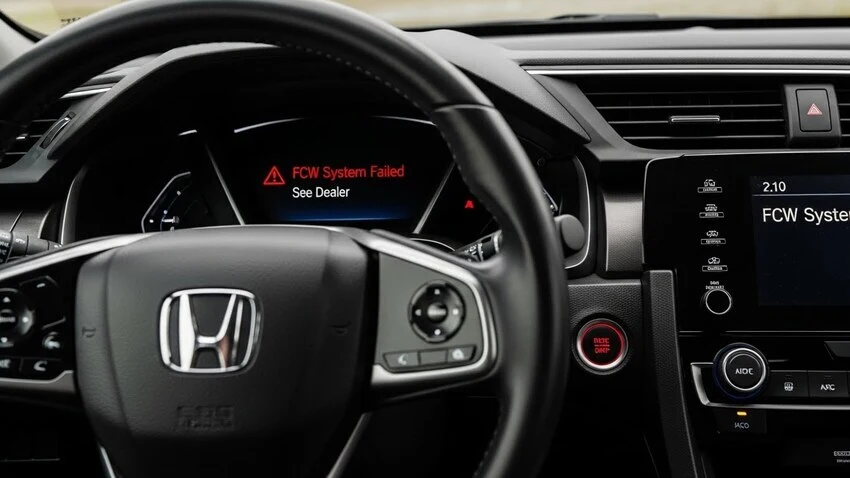
The most obvious sign is the text message on your driver information interface: “FCW System Failed” or “Brake System” indicators lighting up in orange. You might also see the dedicated FCW/FCI icon remain illuminated on the dash.
Erratic Behavior
Before the system fails completely, it might act strangely. You may experience false positive warnings, where the car beeps frantically at an empty road or a shadow under a bridge. Conversely, you might notice the system failing to alert you when you actually are approaching a stopped car too quickly.
Intermittent Failures
Electronic gremlins can be frustratingly inconsistent. Your FCW system might work perfectly on your morning commute, but fail during the drive home. This “on-again, off-again” behavior is a classic sign of either an environmental issue (like heat) or a loose electrical connection.
Why Does the “FCW System Failed” Message Appear?
If your dashboard is lit up like a Christmas tree, don’t panic. The root cause is often much simpler than a blown computer module. We will break down the causes from the most common to the most complex.
Environmental Factors and Sensor Obstruction
Believe it or not, the number one enemy of high-tech safety sensors is nature itself. Since the system relies on “seeing” the road, anything that blocks its vision causes a failure.
Physical Blockages are the most frequent culprits. If you have been driving through slush, snow, or mud, a thin layer of grime on your front Honda emblem (where the radar lives) creates a blindfold. The system detects that its view is blocked and shuts down to prevent giving you false information. Even a large dead insect splattered directly on the sensor can trigger a warning.
Weather Interference plays a huge role as well. Heavy rain, dense fog, or a blizzard can scatter the radar waves and obscure the camera’s lens. If the camera cannot see the lane lines or the car ahead, it throws the error code. Similarly, Extreme Heat can affect the windshield-mounted camera. If you park your car facing the sun on a scorching day, the camera unit can overheat and temporarily disable itself until the cabin cools down.
Here is Part 2 of the article.
Electrical and Power Supply Issues
Your car is essentially a rolling computer, and like any computer, it needs a steady power supply to run complex programs. Modern Honda vehicles are notoriously sensitive to voltage fluctuations.
Battery Voltage is often the silent culprit. If your battery is nearing the end of its life, it might still have enough juice to start the engine, but the voltage could drop too low during that initial crank. When this happens, the sensitive ADAS modules may fail to initialize properly. The car starts, but the safety systems don’t boot up, triggering the warning light immediately.
Wiring Integrity also matters. Over time, the wiring harness connecting your front radar to the main computer can suffer from corrosion, especially if you live in an area where roads are salted in winter. In some unfortunate cases, rodents seeking warmth might chew through these wires, severing the connection entirely.
Software and Calibration Problems
Sometimes the hardware is fine, but the system’s “aim” is off. The camera and radar must be perfectly aligned to calculate distance accurately.
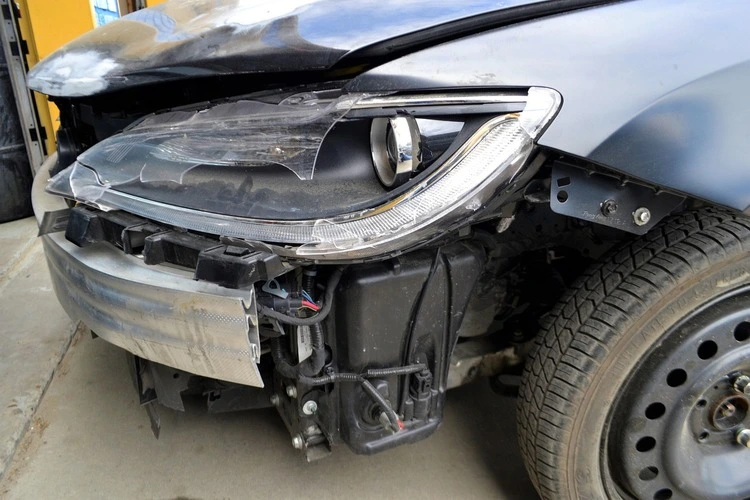
Loss of Calibration is a frequent issue after repairs. Did you recently have your windshield replaced? If the technician didn’t precisely recalibrate the camera, or if they used aftermarket glass that distorts the lens’s view, the system will fail. Similarly, even a minor fender bender can knock the front radar bracket out of alignment by just a few millimeters, which is enough to disable the system.
Software Glitches can also occur. Just like your smartphone, your car’s firmware can have bugs. Honda occasionally releases software updates to fix these logic errors, which is why checking with a dealer is sometimes the only fix.
The “Ripple Effect”: ABS and VSA Module Failures
The systems in your car talk to each other. The FCW system relies on data from the Vehicle Stability Assist (VSA) and Anti-lock Braking System (ABS) to know how fast you are moving.
If a single wheel speed sensor fails, or if the ABS modulator develops a fault, the car can no longer accurately determine its speed. Without speed data, the FCW system cannot calculate “time to collision,” so it automatically shuts down. Often, you will see the FCW warning light appear simultaneously with VSA and ABS warning lights.
Which Honda Models Are Most Affected?
While this technology is standard across most of the lineup, some models seem to suffer from these glitches more than others.
Honda Accord
The Accord, particularly models from 2013 to 2017 and the newer 2018+ generation, has a high number of reported FCW issues. Owners often report “phantom braking” scenarios where the shadow of a bridge or a sign triggers the sensor.
Honda Pilot and Odyssey
Larger vehicles like the Pilot face their own challenges. Due to their height and the positioning of sensors, they can be more prone to misalignment from minor bumps. If you are considering a used model, it is worth checking the specific Honda Pilot years to avoid, as some model years have widespread electrical complaints that go beyond just the collision sensors.
Honda CR-V and Crosstour
The CR-V is another popular model that isn’t immune. Similar to the Pilot, certain production years have a reputation for sensitive electronics. Before purchasing a used SUV, reviewing the Honda CR-V years to avoid can save you from inheriting a vehicle with persistent electrical gremlins.
Is It Safe to Drive with the FCW Warning Light On?
This is the most common question we hear. The short answer is: Yes, it is safe to drive, but you must be more vigilant.
When the “FCW System Failed” message is on, your car’s fundamental mechanical systems—brakes, steering, and engine—are largely unaffected. You can still drive to work or the grocery store without fear of the car shutting down on the highway.
However, you have lost a critical safety net. You will not get an audible warning if traffic suddenly stops ahead of you. Furthermore, if your vehicle is equipped with Adaptive Cruise Control (ACC), that feature will likely be disabled as well since it shares the same radar sensor. Drive defensively and leave extra space between you and the car in front until you can get the system fixed.
DIY Troubleshooting and Diagnostics
Before you rush to the dealership and pay a diagnostic fee, there are several troubleshooting steps you can do right in your driveway.
Visual Inspection Checklist
Start with the easiest and cheapest fix: cleaning.
- Inspect the Emblem: Look closely at the “H” emblem on your front grille. Is it covered in dried mud, road salt, or bug splatter? Wipe it clean gently using a damp microfiber cloth.
- Check the Windshield: Look at the area of the glass directly in front of the rearview mirror. Is there a streak of dirt, bird droppings, or condensation blocking the camera lens? Clean this area thoroughly inside and out.
- Look for Damage: Inspect the front bumper and grille for any cracks or dents. Even a small impact can push the radar sensor out of alignment.
Here is Part 3 of the article.
How to Perform a System Reset
If cleaning the sensors doesn’t clear the error, the next step is to reboot the car’s brain. Electronics can get stuck in a logic loop, and a simple reset can often clear a temporary glitch.
The Soft Reset: First, try turning the car off and on again. If that fails, go into your Vehicle Settings menu on the infotainment screen. Navigate to Driver Assist System Setup and look for an option to reset or restore default settings.
The Hard Reset (Battery Disconnect): This is the “nuclear option” for home mechanics but is very effective.
- Turn off the engine and open the hood.
- Use a 10mm wrench to disconnect the negative (black) battery terminal.
- Leave it disconnected for 15 to 20 minutes. This drains the residual power from the capacitors in the ECU.
- Reconnect the terminal and tighten it securely.
- Start the car and drive for a few miles. The system might need a short drive to recalibrate itself.
Advanced Diagnostics: Reading OBD-II Error Codes
If the light persists, you need to ask the car what’s wrong. A basic engine code reader might not work here; you need a scanner capable of reading ADAS and ABS codes.
Plug the scanner into the OBD-II port under the dashboard. You are looking for codes like:
- C1A01: This points specifically to a malfunction in the radar sensor itself.
- U0235 or U0200: These “U” codes indicate a communication loss, meaning a wire might be cut or a plug is loose.
When to Seek Professional Help: Repair and Calibration Costs
If DIY steps fail, you are likely looking at a hardware failure or a calibration issue that requires specialized equipment.
Recalibration Costs: If you need a recalibration (often required after a windshield replacement), expect to pay between $250 and $600. Independent shops specializing in ADAS can sometimes do this cheaper than the dealer.
Hardware Replacement: If the radar unit or camera is physically damaged, parts are expensive. A new radar unit can cost $700 to $1,500 depending on your model year. This is why investing in a grille guard or being careful in parking lots is worth it.
Dealer vs. Independent Shop: For simple sensor replacements, a trusted independent mechanic is fine. However, for complex software updates or sensitive calibration, the dealership is often the safer bet because they have the proprietary Honda targeting boards and software.
Legal Perspectives: Defects and Recalls
Is this failure just bad luck, or is it a defect? Honda has faced scrutiny over its collision avoidance systems. There have been investigations and class-action lawsuits regarding “phantom braking” and persistent system failures in models like the Accord and CR-V.
Before paying out of pocket, always check the NHTSA website or call your dealer with your VIN number to see if there is an open recall or a warranty extension for your specific vehicle. You might get the repair done for free.
FAQs
Yes, most Hondas allow you to disable the system via a button to the left of the steering wheel or in the vehicle settings. However, the orange warning light may stay illuminated to remind you that the system is off.
It can. If you install a custom grille that blocks the radar or changes its position, the dealer can deny a warranty claim for that specific system.
No. The airbags operate on a separate system using different impact sensors. Your airbags will still deploy in a crash even if the FCW is offline.
Conclusion
The “FCW System Failed” message is annoying, but it is not a death sentence for your car. It is a reminder that modern vehicles are complex machines that need clear vision and steady power to keep you safe.
Start with the basics: wash your car, check your battery, and inspect for damage. If those don’t work, don’t hesitate to seek professional help. Your safety—and the safety of those driving in front of you—is worth the investment.