How Are Fault and Liability Determined in Jackknife Accidents?
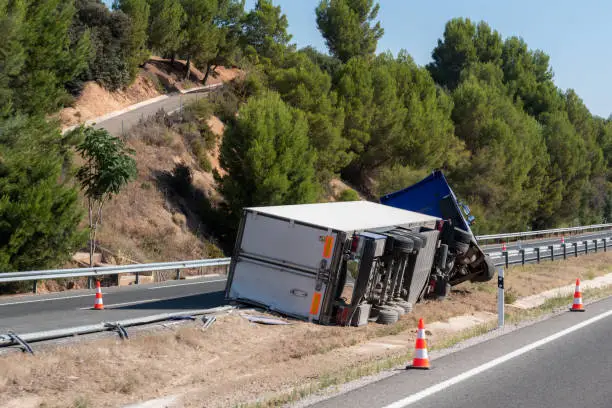
When discussing jackknife accidents, it is important to understand how these incidents happen and why they are legally complicated. A jackknife accident occurs when a truck’s trailer swings out at an angle, forming a shape similar to a folding knife. This type of crash often leads to serious damage and raises difficult questions about responsibility.
What Causes a Jackknife Accident?
To begin with, understanding the causes helps clarify how fault is determined. Jackknife accidents usually occur when a truck loses traction, causing the trailer to slide sideways.
Several factors can contribute to this situation. Sudden braking is one of the most common causes. If a driver brakes too hard, especially on wet or icy roads, the trailer may swing out of control. Speeding, poor road conditions, and improper loading can also increase the risk.
Because these accidents often result from a combination of issues, investigators must carefully review each factor before assigning blame.
The Role of Driver Negligence
Next, driver behavior plays a major role in determining liability. Truck drivers are expected to follow strict safety standards and operate their vehicles with care.
If a driver was speeding, distracted, or failed to adjust to weather conditions, they may be considered negligent. For example, driving too fast on a slippery road increases the likelihood of losing control.
In such cases, the driver may be held responsible for the accident. However, this is only one part of the overall analysis.
Trucking Company Responsibility
In addition to the driver, the trucking company may also share liability. Companies are responsible for hiring qualified drivers, providing proper training, and maintaining their vehicles.
If a company fails to enforce safety policies or pressures drivers to meet unrealistic deadlines, it may contribute to unsafe driving conditions. Similarly, poor maintenance, such as worn brakes or faulty tires, can increase the risk of a jackknife accident.
Therefore, investigators often examine company records, maintenance logs, and training procedures to determine whether the employer played a role.
The Impact of Cargo Loading
Another important factor is how the truck was loaded. Improperly balanced or unsecured cargo can make a trailer unstable.
When weight is unevenly distributed, it can shift during braking or turning, increasing the chance of a jackknife. In some cases, a third party responsible for loading the truck may be at fault.
This adds another layer of complexity, as liability may extend beyond the driver and trucking company.
Road and Weather Conditions
At this point, external factors must also be considered. Road conditions, weather, and even poor signage can contribute to an accident.
For instance, icy roads or heavy rain can reduce traction and make it harder to control a large truck. While these conditions do not automatically remove responsibility, they may influence how fault is shared.
Government agencies or contractors may also be involved if poor road maintenance or design contributed to the crash.
How Evidence Is Used to Determine Fault
To connect all these factors, investigators rely on various types of evidence. This includes police reports, witness statements, and photographs from the scene.
In addition, modern trucks often have electronic logging devices that record speed, braking patterns, and driving hours. This data can provide valuable insight into what happened before the accident.
Accident reconstruction experts may also be used to recreate the event and identify the sequence of actions that led to the crash.
Shared Liability in Many Cases
Because jackknife accidents are complex, liability is often shared. This means more than one party may be held responsible for the damages.
For example, a driver may be partially at fault for speeding, while the trucking company may share responsibility for poor maintenance. In such cases, courts or insurance companies assign a percentage of fault to each party.
This system ensures that responsibility is distributed fairly based on each party’s role in the accident.
Key Takeaways
- Fault in jackknife accidents is determined by analyzing evidence and identifying negligence.
- Driver actions such as speeding or sudden braking often play a key role.
- Trucking companies may be liable for poor training or vehicle maintenance.
- Improper cargo loading can increase the risk of accidents.
- Road and weather conditions may influence how fault is assigned.
- Evidence like electronic logs and witness statements is crucial.
- Liability is often shared among multiple parties.