How Long Does PPF Last? Realistic Expectations for Tesla Car Owners
Paint protection film is a clear urethane layer that shields Tesla paint from chips, scratches, and UV fade. This guide explains how PPF is constructed, what material types are common, and which panels benefit most from coverage.
It compares full-body wraps with partial protection, outlining typical price ranges and the visual and practical trade-offs of each choice. You will also see why installation skill affects both durability and finish, from surface prep to alignment on complex Tesla curves.
The aim is to help owners set realistic expectations for lifespan, upkeep, and value over time.
What Is Paint Protection Film (PPF)?
Paint Protection Film acts as an amazing shield for your vehicle’s surface. This transparent layer defends your car’s appearance against everyday hazards.
How PPF Works
PPF uses multiple layers that work together to protect your Tesla’s paint. The core is a thermoplastic urethane film that absorbs and spreads out impact energy. This smart design keeps chips, scratches, and other damage away from the paint underneath.
Here’s the science behind PPF’s multi-layer build:
- A polyester release liner that protects the adhesive before installation
- An adhesive layer that sticks firmly to your Tesla’s paint
- A polyurethane middle layer that absorbs impacts
- A clear top coat with protective qualities
Quality PPF has an incredible self-healing ability. Small scratches and swirl marks vanish with heat from sunlight or a heat gun. Your Tesla stays looking perfect without constant touch-ups.
The film does more than just provide physical protection. It guards your car against UV radiation. This stops the paint from fading and breaking down after long sun exposure, a great way to keep your Tesla’s exterior looking fresh.
Types of PPF Materials
PPF quality varies between products. Material quality determines how well it performs and how long it lasts.
Today’s market offers two main types:
- TPU (Thermoplastic Polyurethane): This is the best PPF you can get. It bends easily, lasts long, and resists UV rays and chemicals. TPU films stay clear without yellowing and usually come with 5-10 year warranties.
- PVC (Polyvinyl Chloride): A starter option that gives simple protection without fancy features. PVC films don’t bend as well, wear out faster, and turn yellow as they get older.
- Advanced choices include:
- Self-Healing PPF: The top layers fix minor scratches with heat. The film’s molecules reshape themselves to make marks disappear.
- Instant-Healing PPF: This advanced option uses nanotechnology to fix damage right after impact. Some versions add ceramic coating on top for extra smoothness.
- Matte or Satin PPF: These options protect while changing your Tesla’s look.
Where It’s Applied On The Car
You can cover your whole car with PPF or just protect specific areas. Tesla’s paint issues make smart placement crucial for protection.
PPF usually goes on these spots:
- Front bumper and grille – catching road debris at highway speeds
- Hood and front fenders – highly exposed to rock chips
- Side mirrors – frequently hit by small stones
- Door edges and handles – prone to scratches from daily use
- Rocker panels – vulnerable to road debris kickup
- Rear fenders – especially important for Tesla models, as mentioned in owner reports
Tesla owners worried about their car’s color should consider full-body coverage. This method protects all painted surfaces from damage. Some choose partial coverage for high-risk areas to balance protection and cost.
Tesla’s thin paint makes full coverage the best solution to protect your car’s finish. Many first-time PPF users start with partial coverage on front-facing surfaces before deciding on complete coverage.
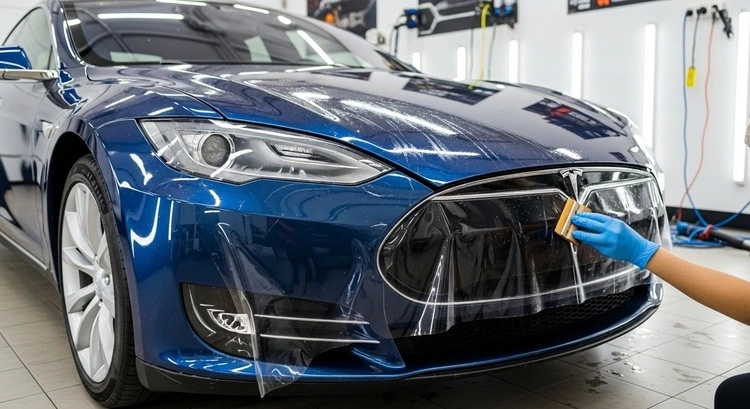
Professional installation is key because PPF must fit perfectly around your Tesla’s curves. Proper application needs special techniques with steam, heat guns, and precise cutting methods.
Full vs. Partial PPF Coverage
The choice between full and partial PPF coverage is like picking between a complete suit of armor or strategic protective gear for your Tesla. Each choice has its own advantages based on your driving habits, budget, and what you plan to do with your vehicle.
What Full-Body PPF Has
Your Tesla becomes a fortress with full-body PPF that covers every external painted surface.
This complete protection has:
- The entire front end (hood, fenders, bumper, headlights)
- All door panels and the roof
- Rear quarters, trunk, and rear bumper
- Side mirrors and other vulnerable areas
The uninterrupted application creates an invisible barrier without transition lines or exposed seams. This full coverage gives your Tesla’s appearance consistency while it guards against environmental factors we discussed earlier.
Full-body coverage shines with its “invisible protection” quality; people can’t tell the film is there. Your Tesla’s factory appearance stays intact, whatever the paint color or finish type.
Automotive protection experts say that complete coverage is a great way to get resale protection for your investment. A Tesla with a full wrap usually holds more value over time since the original paint stays pristine under this transparent shield.
At The Time, Partial PPF Works
Partial PPF takes a targeted approach to protecting your Tesla’s exterior. This option defends the high-impact zones where damage happens most:
The front bumper guards against bugs and road debris; paint damage often starts here. Partial hood protection (usually 18-24 inches) blocks most highway-kicked stones. Fender and mirror guards round out the focused protection package.
Partial coverage makes sense in certain situations:
- City driving with limited highway time works well. Urban areas usually have fewer high-speed debris risks. Garage-kept cars used mainly for weekend drives rather than daily commutes are another good fit. The same goes for owners planning to upgrade to newer Tesla models soon.
- Partial PPF protects Tesla paint effectively in these cases without the full coverage cost. The trade-off shows in visible seam lines where the film ends, which affects the overall look.
Cost Differences To Think Over
The price difference between coverage options is big enough to sway most decisions. Partial PPF costs between $700 USD – $2,500 USD based on the protected areas. This basic protection covers the most vulnerable parts but leaves others exposed.
Full-body protection is a bigger investment, ranging from $4,000 USD – $8,000 USD for total coverage. This is what you’ll pay for premium protection of your Tesla’s color and maximum resale value.
Your driving environment should guide your coverage choice. Highways with lots of debris, gravel roads, or construction zones need complete protection. Regular drives in controlled settings might work fine with partial coverage.
Your Tesla’s future value matters too. Full PPF often pays off through better resale prices; protected Teslas usually sell for more. Partial coverage gives good protection for less money upfront, but might need touch-ups later.
Here’s something people often miss: repair savings over time. Areas without PPF might need expensive paint correction or panel repainting, costs that often go above $1,500 for multiple chips and scratches. These potential costs should factor into today’s decision.
The final choice comes down to balancing what you can spend now against long-term protection goals. Many Tesla owners start with partial coverage on high-impact areas and upgrade to full protection when their budget allows.
Why Professional Installation Matters
The gap between DIY and professional PPF installation is like comparing paint-by-numbers to creating a masterpiece. Professional installation protects your PPF investment’s appearance and durability. Let’s get into why experts make such a big difference.
Avoiding Bubbles And Misalignment
DIY PPF installations often leave visible bubbles, wrinkles, and misaligned edges. Professional installers work in controlled environments and use specialized techniques to avoid these issues.
A dust-free workspace keeps contaminants from getting trapped under the film. Picture trying to put a screen protector on your phone, but your Tesla has hundreds of complex curves and angles!
Professional installers have tools that aren’t accessible to DIY enthusiasts:
- Heat guns to shape film around curved surfaces
- Computer-cut plotters for exact measurements
- Specialized squeegees and slip solutions to eliminate bubbles
Professionals know to use light, even pressure instead of forceful strokes when removing air bubbles. They can separate air bubbles from moisture bubbles and fix each one properly.
Numbers tell the story: 95% of experts say proper cleaning and surface preparation are crucial to prevent adhesion issues. Without professional preparation, dust particles and residue get trapped under the film and create bubbles.
Certified Installers For Tesla Models
Your Tesla needs more than just any shop for protection. Certified installers complete specific training for Tesla’s unique body shapes and paint characteristics.
Quality installers get their certification through intensive programs like XPEL University or 3M Performance Materials Institute. These certifications confirm they can handle the unique challenges of protecting your Tesla’s exterior.
Experience makes a huge difference. Installers who’ve completed over 500 Tesla film jobs show they can deliver bubble-free installation with perfect film tension across curved surfaces. This expertise leads to better results for your vehicle.
Professional installation includes multi-stage preparation. Certified technicians often fix paint imperfections before applying PPF to create a smooth surface that helps the film stick better and look great.
To ensure the best results, prioritize manufacturer-certified installers in the Toronto area. Pick the experts from ID Protection who specialize in high-end Tesla PPF applications.These professionals understand exactly what Model S, 3, X, and Y bodies need.
Warranty And Long-Term Performance
Warranties might be the best reason to choose professional installation. Professional PPF installations come with guarantees that cover materials and workmanship.
Quality installers give 5-10 year warranties against:
- Yellowing of the film
- Cracking or peeling edges
- Adhesive failure
These warranties give you protection that DIY kits can’t match. You’re covered if anything goes wrong because of installation problems or material defects.
A professional application makes your PPF last longer. Professional-grade materials look clearer, last longer, and heal themselves better than consumer-grade products used in DIY installations.
Professional installation costs more than DIY ($2,000 USD to $7,000 USD). Notwithstanding that, this investment pays off through perfect protection and avoiding expensive DIY mistakes.
Professional installation protects your Tesla’s appearance and resale value. Professional installers give you results that DIY methods just can’t match with their expertise, equipment, and guarantees.
Conclusion:
PPF can keep a Tesla finish in better shape when exposed to highway grit, parking-lot scuffs, and strong sun. TPU films usually offer longer life and clearer looks than PVC, and self-healing coats handle light scratches with heat.
Your best coverage level depends on mileage, driving conditions, and resale plans. Full wraps protect every painted panel, while partial kits focus on high-impact areas at a lower upfront cost.
Whatever the option, professional fitting reduces bubbles, edge lift, and visible seams, and it often includes multi-year warranty support. With the right film and careful installation, protection stays consistent for years.