Advanced Clutch Technology Is Reshaping Modern Manufacturing
Manufacturing lines move fast. Equipment downtime costs money. The drivetrain systems connecting motors to machinery must perform reliably under extreme stress, and that demand is driving rapid innovation in advanced clutch technology.
Across automotive, industrial, and heavy equipment sectors, clutch systems have evolved far beyond simple friction-based engagement. Engineers now design clutches that respond to electronic signals, manage heat dynamically, and integrate with broader powertrain control systems. For U.S. manufacturers, understanding these developments is essential to staying competitive.
Why Traditional Clutch Systems Are No Longer Enough
Older clutch designs were built for simpler applications. They worked well when torque loads were predictable and engagement speeds were low.
Modern manufacturing environments are different. Automated assembly lines demand precise, repeatable clutch engagement across millions of cycles. High-speed stamping presses, robotic actuators, and CNC equipment require clutches that engage and disengage in milliseconds without slipping, overheating, or wearing unevenly.
Traditional wet and dry plate clutches struggle to meet these standards at scale. They generate excess heat under high-cycle conditions. Their engagement characteristics degrade over time. Maintenance intervals shorten, and unplanned downtime increases.
The manufacturing sector needed better solutions. Advanced clutch technology delivered them.
Key Innovations Driving the Field Forward
Several engineering breakthroughs have transformed clutch performance across industrial and automotive applications.
Electrohydraulic and Electromechanical Actuation
Hydraulic clutch actuation has long been standard in heavy-duty applications. The integration of electronic controls changed its capabilities significantly.
Electrohydraulic systems use solenoid valves and pressure sensors to modulate clutch engagement with fine precision. Shift timing, engagement pressure, and release speed are all programmable. This allows manufacturers to optimize clutch behavior for specific equipment, reducing shock loads and extending component life.
Electromechanical actuation goes further. Electric motors replace hydraulic circuits entirely in some designs. The result is faster response, lower energy consumption, and better compatibility with digital control systems.
Advanced Friction Materials
Friction material science has advanced considerably over the past two decades. Carbon-carbon composites, sintered metallic compounds, and ceramic-based materials now offer heat resistance and wear characteristics that traditional organic compounds cannot match.
Carbon-ceramic friction materials, for example, maintain consistent performance at temperatures exceeding 600°C. They are increasingly used in high-performance automotive clutches and industrial press applications where thermal cycling is severe.
Sintered metallic materials provide excellent torque capacity in wet clutch environments. They resist glazing and maintain stable coefficients of friction across wide temperature ranges, a critical requirement in automated transmission systems.
Torque Limiting and Overload Protection
Modern clutch systems increasingly incorporate torque-limiting functionality. These designs allow a calibrated slip point, protecting downstream drivetrain components from shock loads.
In precision manufacturing equipment, this matters. A sudden jam in a conveyor or press can transmit enormous force spikes through a drivetrain. Torque-limiting clutches absorb that energy before it reaches gearboxes, motors, or structural frames.
Ball-detent, friction-based, and magnetic torque limiters each serve different load profiles. Selecting the right type requires careful analysis of application speed, inertia, and the frequency of overload events.
Clutch Technology in Automotive Manufacturing
The automotive sector is both a major user of advanced clutch systems and a key driver of their development.
Dual-Clutch Transmissions
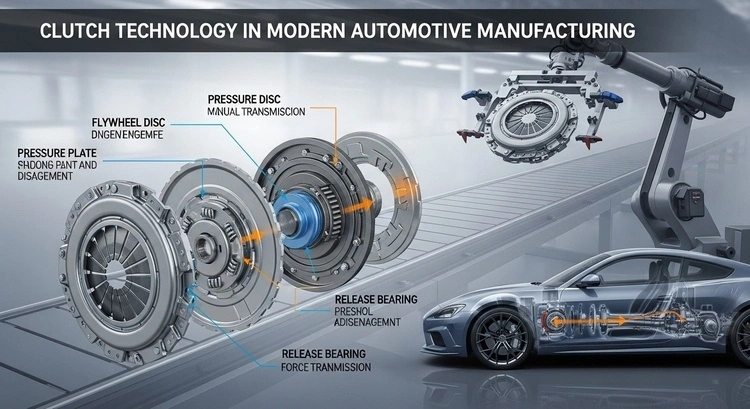
Dual-clutch transmissions (DCTs) represent one of the most significant advances in automotive powertrain engineering. They use two separate clutch packs, one for odd gears, one for even, allowing near-seamless gear changes without torque interruption.
DCTs deliver faster shifts than traditional automatics while maintaining better fuel efficiency than conventional manual transmissions. They are now standard in a wide range of passenger vehicles and are increasingly adopted in commercial truck applications.
For the manufacturing facilities assembling these vehicles, DCT components demand tighter tolerances and more sophisticated testing protocols than older transmission systems.
Hybrid and Electric Vehicle Integration
Hybrid powertrains introduce additional complexity. Clutch systems must manage torque handoff between internal combustion engines and electric motors, often multiple times per second under varying load conditions.
Some hybrid architectures use disconnect clutches to fully decouple the engine from the drivetrain during electric-only operation. These clutches must engage smoothly when power demand increases, without causing driveline shudder or hesitation.
As EV adoption grows, clutch applications are shifting toward e-axle systems, two-speed EV gearboxes, and torque vectoring differentials. These represent new design challenges and significant growth opportunities for manufacturers specializing in clutch components.
Selecting the Right Clutch Partner
For manufacturing operations evaluating clutch suppliers, technical depth matters as much as product catalog breadth.
Leading suppliers bring application engineering expertise to the table. They analyze torque requirements, duty cycles, thermal environments, and control system compatibility before recommending a solution. They also provide ongoing support as production conditions change.
FCC NA is one of the best suppliers with deep roots in clutch system development for automotive applications. The company supports OEM and Tier 1 manufacturers with engineered friction and clutch solutions across a range of powertrain configurations.
When evaluating suppliers, manufacturers should assess prototyping capability, materials testing infrastructure, and experience with the specific application type. References from comparable production environments carry significant weight.
What Comes Next for Industrial Clutch Systems
Several trends will shape clutch technology development over the next decade.
Predictive maintenance integration is accelerating. Embedded sensors in clutch assemblies now monitor temperature, slip frequency, and engagement force in real time. Connected to industrial IoT platforms, this data enables condition-based maintenance, replacing scheduled service intervals with intervention only when actual wear thresholds are approached.
Additive manufacturing is beginning to influence clutch component production. Complex internal geometries that were previously impossible to machine are now achievable through metal 3D printing. This opens new possibilities for thermal management channels, weight reduction, and custom friction surface profiles.
Sustainability pressures are also reshaping materials selection. Manufacturers are moving away from compounds containing hazardous substances, driven by both regulatory requirements and customer expectations. Copper-free friction materials and low-emission manufacturing processes are becoming standard requirements in OEM supply chains.
Verdict
Advanced clutch technology sits at the intersection of mechanical engineering, materials science, and digital controls. For U.S. manufacturers, keeping pace with these developments is not optional; it is a competitive necessity. The equipment that runs your facility, and the vehicles your facility helps produce, depend on clutch systems performing at the edge of what engineering currently makes possible.