Why Diagnostic Software Is Now the Core Tool in Heavy-Duty Truck Maintenance
There was a time when truck maintenance was mostly mechanical. A good technician could listen to an engine, feel how a gearbox behaved, or visually inspect components and quickly understand what was wrong.
That time is gone.
Today’s trucks are built around electronic systems. Engines, transmissions, emissions systems, braking, and even auxiliary functions are controlled by software. What used to be physical problems are now often digital ones, hidden inside control units and sensor data.
And that has completely changed how diagnostics work.
The Shift from Tools to Software
In the past, a diagnostic tool was just a device used occasionally when something went wrong. Now, diagnostic software is something technicians rely on daily.
Every modern truck continuously generates data. Temperatures, pressures, fuel behavior, emission cycles, fault history. Without software, this data is inaccessible. And without access, technicians are working blind.
That’s why software is no longer an optional add-on. It has become the primary way to understand what is happening inside a vehicle.
The Real Advantage: Speed and Accuracy
The biggest benefit of using modern diagnostic software is not just information. It’s speed.
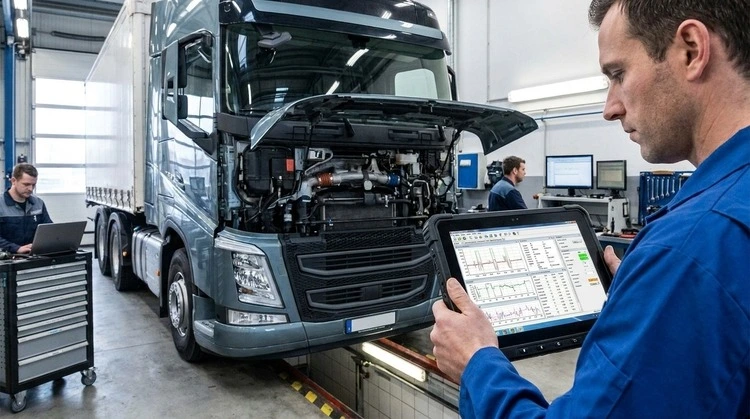
Instead of spending hours checking components manually, technicians can connect to the system and immediately see fault codes, system status, and live data.
This changes everything.
A problem that used to take half a day to identify can now be confirmed in minutes. And in fleet operations, those hours saved directly translate into money.
Not Just Trucks Anymore
Another important change is that diagnostic software is no longer limited to one type of vehicle.
Workshops today often deal with:
- trucks
- construction equipment
- agricultural machines
- industrial engines
Each of these systems has its own control modules and communication protocols. Managing them separately creates inefficiency.
This is why there is a growing demand for professional diagnostic software for trucks and heavy equipment, allowing technicians to work across different machines without constantly switching tools.
From Fault Codes to Full System Control
Modern diagnostic platforms are not just about reading errors.
They allow technicians to:
- monitor live system behavior
- perform calibrations
- adjust parameters
- run component tests
- analyze historical data
This level of access means repairs are no longer based on assumptions. They are based on actual system feedback.
And that reduces both mistakes and unnecessary part replacements.
The Role of Experience Has Changed
Good technicians are still essential. But their role has evolved.
Instead of relying purely on instinct, they now combine experience with data. The software provides direction, but the technician decides how to act on it.
This combination leads to better decisions, faster repairs, and more consistent results across different types of equipment.
Why Workshops Are Adapting Quickly
Workshops that adopt proper diagnostic software early gain a clear advantage.
They work faster.
They diagnose more accurately.
They reduce repeat repairs.
In contrast, workshops that rely only on traditional methods struggle to keep up with modern systems.
The gap between these two approaches is growing every year.
Conclusion
Heavy-duty vehicles are becoming more advanced, more connected, and more dependent on software.
Trying to maintain them without proper diagnostic access is no longer realistic.
What used to be a supporting tool has now become the foundation of modern maintenance.
For workshops and fleet operators, investing in the right diagnostic software is not just about convenience. It is about staying operational, competitive, and efficient in a rapidly evolving industry.