10 Best Affordable Drift Cars: A Comprehensive Guide
Let’s be honest: Motorsport is rarely cheap, and drifting is no exception. Between the tires you will inevitably shred, the track entry fees, and the constant mechanical upkeep, the costs stack up quickly. However, the secret to successfully entering the drifting world without draining your bank account is choosing the right foundation.
Your initial investment—the car itself—dictates your entire operational budget moving forward. If you buy an overly complicated or rare vehicle, you will spend a fortune on custom fabrication and obscure replacement parts. To keep your overhead low and maximize your actual seat time on the track, you need to start with a reliable, widely supported rear-wheel-drive platform. Fortunately, you can easily secure a highly capable chassis that pushes plenty of power to the rear wheels for well under the $5,000 to $10,000 mark.
What Makes a Great Entry-Level Drift Car?
Before you hand over any cash, you need to understand exactly what mechanical ingredients make a car slide predictably. You cannot just pick any cheap car off a used lot and expect it to hold a controlled drift.
First and foremost, you absolutely need a rear-wheel-drive (RWD) layout. Front-wheel-drive cars simply drag their rear wheels, and while all-wheel-drive cars can powerslide, RWD allows you to independently manage front steering and rear traction. Second, you want a manual transmission. A manual gearbox gives you the ability to perform a “clutch kick”—a technique where you dump the clutch to send a sudden shock of RPMs to the rear end, instantly breaking traction.
Weight distribution also plays a massive role. You want a car that sits as close to a 50/50 front-to-rear weight balance as possible. This balance keeps the car from snapping aggressively when you transition from one corner to the next. Finally, you need a serviceable differential. Factory “open” differentials send power to the wheel with the least resistance, which ruins a drift. You will either need to weld the factory differential or install a Limited-Slip Differential (LSD), so both rear wheels spin together consistently.
The 10 Best Drift Cars You Can Actually Afford (From $5K to $20K)
The used car market is packed with excellent options from the 1990s and early 2000s that fit these exact criteria. Whether you prefer the handling of a lightweight Japanese coupe, the raw torque of an American V8, or the balanced precision of a German sedan, there is a perfect starter chassis waiting for you.
1. Nissan 350Z (2003–2008) & Infiniti G35 Coupe
The Nissan 350Z and its luxury sibling, the Infiniti G35, have rapidly become the modern gold standard for grassroots drifting. Under the hood, both cars utilize the VQ35DE V6 engine (and the VQ35HR in later models), pushing out roughly 280 to 306 horsepower right from the factory.
This is the perfect amount of power for a beginner. It is enough grunt to easily break the rear tires loose without requiring expensive turbo kits or engine swaps. Furthermore, the 350Z features an incredibly strong factory rear subframe and a robust 6-speed manual transmission that can take a beating all season long.
Why it’s great for drifting:
The VQ engine provides a massive wave of low-end torque, meaning you can initiate a drift with a simple clutch kick without needing to keep the engine screaming at the redline. As older legendary chassis like the 240SX become painfully expensive, the 350Z has stepped up as one of the most budget-friendly JDM cars available today. The aftermarket support is endless, making parts like drift-spec coilovers and steering angle kits incredibly cheap and easy to source.

2. BMW 3-Series: E36 and E46 330Ci (1992–2006)
If you prefer European engineering, the BMW E36 and E46 chassis are virtually factory-ready drift cars. You do not need an expensive M3 to get sideways. The standard E36 325i or 328i, along with the E46 330Ci, offer incredible value and precise handling.
These models come equipped with BMW’s naturally aspirated inline-six engines (like the M50, M52, or M54). For instance, the M54B30 in the E46 330Ci produces a healthy 225 horsepower. BMW designed these cars with near-perfect 50/50 weight distribution, which translates to a highly predictable and stable car mid-drift.
Why it’s great for drifting:
The true treasure of these older 3-Series models is their engine blocks. These inline-six engines are incredibly tough when properly maintained, easily surviving the high-RPM abuse that drifting demands. To get started, all you really need to do is weld the differential and refresh the factory cooling system. Because BMW manufactured millions of these cars globally, finding cheap replacement parts at your local salvage yard is an absolute breeze.
3. Mazda MX-5 Miata NB/NC (1990–2015)
If you want to master the true art of car control, nothing beats a Mazda Miata. Often weighing well under 2,200 pounds, this ultra-lightweight roadster forces you to rely entirely on momentum rather than horsepower. The earlier NB models feature a modest 1.8-liter four-cylinder engine, while the later NC generation bumps up the power slightly. Because the Miata lacks brute force, you cannot just mash the throttle to get out of trouble. Instead, it teaches you the precise footwork and steering inputs required to link corners smoothly.
Why it’s great for drifting:
The Miata boasts an incredibly short wheelbase, which makes its handling ultra-responsive. When the rear end kicks out, it happens fast. Learning to catch and hold a drift in a vehicle this snappy ultimately makes you a significantly better driver. Plus, Miatas are famously cheap to buy, insure, and run. A set of 14-inch or 15-inch rear tires will cost you a fraction of what larger sports cars require, making it the ultimate budget-friendly teacher.
4. Ford Mustang GT “New Edge” (1999–2004)
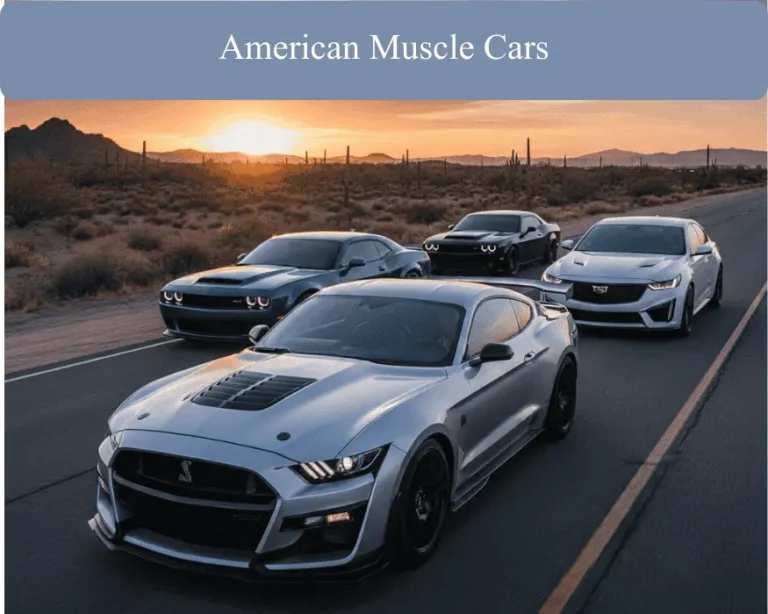
For those who prefer the roar of American muscle, the “New Edge” Ford Mustang GT is an absolute powerhouse for grassroots drifting. Under the hood sits a durable 4.6-liter V8 engine producing 260 horsepower and over 300 lb-ft of torque. Unlike the complex independent rear suspensions found in many European and Japanese cars of the era, this generation of Mustang utilizes a solid rear axle. This setup provides incredibly predictable breakaway characteristics when the rear tires lose traction.
Why it’s great for drifting:
The magic of the Mustang GT lies in its massive low-end torque. You do not need to clutch kick aggressively or keep the RPMs pinned to the redline to initiate a slide; simply rolling onto the throttle breaks traction effortlessly. Additionally, because Ford produced so many of these cars, sourcing replacement parts from Detroit is wonderfully cheap. You can easily find angle kits, tubular K-members, and affordable manual transmissions practically anywhere.
5. Nissan 240SX S13/S14 (1989–1998)
You cannot discuss drift cars without mentioning the legendary Nissan 240SX (known globally as the Silvia). This chassis essentially birthed modern drift culture. The S-chassis provides a near-perfect 55/45 weight distribution and an incredibly agile framework that practically begs to be driven sideways. While American models received the reliable but uninspiring 2.4-liter KA24DE truck engine, the engine bay is spacious enough to accommodate virtually anything you want to drop into it.
Why it’s great for drifting:
The aftermarket support for the 240SX remains unmatched. You can literally build an entire car out of aftermarket catalogs. However, you must be aware of the “drift tax.” Finding a clean, stock S13 or S14 under $5,000 is becoming increasingly difficult due to their iconic status. If you can score a decent shell, dropping in a turbocharged SR20DET or an LS V8 transforms it into a world-class competition vehicle.
6. Chevrolet Camaro / Pontiac Firebird (1993–2002)
The mid-90s to early-2000s F-Body platform is one of the best-kept secrets in budget drifting. Both the Chevrolet Camaro and its twin, the Pontiac Firebird Trans Am, offer tremendous out-of-the-box performance. If you can track down a model equipped with the legendary 5.7-liter LS1 V8 and the bulletproof T56 six-speed manual transmission, you essentially have a professional-grade drivetrain right from the factory.
Why it’s great for drifting:
These American V8s have hit the bottom of their depreciation curve, making them incredibly affordable compared to heavily taxed JDM counterparts. With over 300 horsepower naturally aspirated, you have more than enough power to turn large, sweeping tracks into massive clouds of tire smoke. Strip out the heavy interior, throw on some adjustable coilovers, and you have a fierce drift machine ready for the track.
7. Lexus IS300 (2001–2005)
The Lexus IS300 hides a massive secret under its luxury sedan exterior. Toyota equipped this four-door chassis with the legendary 3.0-liter 2JZ-GE inline-six engine. While this naturally aspirated version lacks the twin turbos of the Supra, the engine block remains virtually bulletproof.
Why it’s great for drifting:
The IS300 offers a slightly longer wheelbase, making your transitions highly predictable. The engine easily handles hours of redline abuse at the track. As your skills progress, the 2JZ-GE provides a fantastic foundation for a bolt-on turbo kit, allowing you to scale the car’s power right alongside your driving ability.
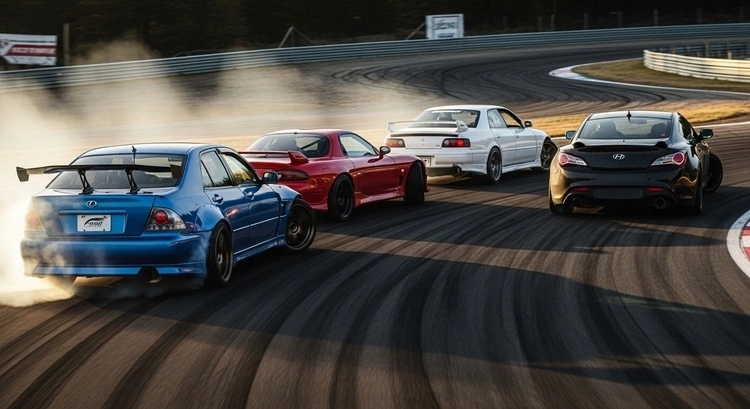
8. Toyota Chaser JZX100
If you want to bring authentic Japanese big-body style to your local track, the Toyota Chaser JZX100 delivers. Depending on import laws in your area, you can still track down these rear-wheel-drive sedans near the top of a budget-friendly price range.
Why it’s great for drifting:
The Chaser utilizes the turbocharged 1JZ-GTE engine, a legendary powerhouse in the drifting community. The elongated body and heavy chassis create incredibly stable, sweeping drifts. The car carries immense momentum through wide corners, and the JDM aftermarket provides endless tuning options for the suspension and drivetrain.
9. Mazda RX-8 (2004–2011)
You can pick up a Mazda RX-8 for incredibly cheap today. Mazda engineered this chassis with a brilliant 50/50 weight distribution and a very low center of gravity.
Why it’s great for drifting:
The 1.3-liter Renesis rotary engine revs to the moon, delivering power in a remarkably smooth, linear fashion. The RX-8 feels incredibly planted and reacts instantly to steering inputs. You do need to stay vigilant about engine maintenance—specifically monitoring oil consumption and apex seals—but the rock-bottom purchase price leaves plenty of room in your budget for upkeep.
10. Hyundai Genesis Coupe (2010–2014)
The Hyundai Genesis Coupe represents a modern, highly capable approach to grassroots drifting. You get a stiff, contemporary chassis paired with a robust 6-speed manual transmission. Buyers can choose between the punchy 2.0-liter turbocharged four-cylinder or the torque-heavy 3.8-liter naturally aspirated V6.
Why it’s great for drifting:
Unlike vehicles from the 1990s, a Genesis Coupe likely won’t require immediate rust repair or complete bushing replacements. It provides modern reliability and aggressive styling right out of the box. Once you master car control in this entry-level platform, you can confidently graduate to aggressive 500 hp cars under 30k to tackle serious competition events.
Essential Upgrades for Aspiring Drifters on a Budget
Do not waste your initial budget trying to add horsepower to your new drift car. A stock engine provides plenty of power to break traction if you configure the chassis correctly. Focus entirely on suspension and safety.
- Welded Differential / LSD: You must lock the rear wheels together. A factory open differential will ruin a slide. Welding your stock diff is the cheapest route, while an aftermarket Limited-Slip Differential provides better street drivability.
- Coilovers: Factory suspension allows too much body roll. Stiff coilovers lower the vehicle’s center of gravity and keep the tires planted during aggressive lateral maneuvers.
- Angle Kits: Modifying your steering knuckles increases your maximum steering lock, allowing you to hold deeper angles without spinning out.
- Racing Seat & Harness: Drifting violently throws your body side-to-side. A fixed-back bucket seat locks you in place so you can focus on steering rather than bracing yourself against the door panel.
Conclusion
Building a competitive track car does not require an endless budget. Seat time always matters more than horsepower. Choose an affordable chassis from this list, weld the differential, bolt in a racing seat, and head to a local skidpad. Focus on mastering clutch kicks, weight transfer, and throttle control. The grassroots drifting community heavily supports drivers who show up willing to learn, so grab your helmet, respect the track limits, and enjoy the slide.