The Truth Behind the Trey Gowdy Car Accident Rumors: A Complete Investigation
In the age of instant information, rumors travel faster than facts. If you follow American politics or watch cable news, you have likely heard the whispers about Trey Gowdy. A persistent story claims the former Congressman and current Fox News host was involved in a devastating car crash.
Search engines are flooded with questions about his health. People want to know if he had facial reconstruction surgery or if a tragic accident forced him off the air. The story is dramatic, tragic, and compelling.
However, after a complete review of public records, police reports, and official statements, one simple truth remains: it never happened.
This article separates the facts from the fiction. We are digging into why thousands of people believe this story, what actually explains the changes in his appearance, and how the internet created a disaster out of thin air. We see this pattern often in online media, similar to the confusion that surrounded the Brittany Johns car accident, where speculation outpaced reality.
Who is Trey Gowdy? A Snapshot of the Man Behind the Headlines
To understand why people care so much about these rumors, you have to look at the man himself. Trey Gowdy isn’t just a TV host; he has been a central figure in American law and politics for decades. His intense style and sharp public persona make him a magnet for attention.
Early Life, Education, and Family
Born in Greenville, South Carolina, Harold Watson “Trey” Gowdy III grew up with a deep connection to his home state. He is the son of Harold and Novalene Gowdy. His roots in Spartanburg run deep, and he often speaks about his upbringing with a sense of Southern pride.
He didn’t stumble into success. Gowdy earned his law degree from the University of South Carolina, setting the stage for a high-stakes career. Despite his busy public life, he has managed to keep his family life relatively private. He resides in Spartanburg with his wife, Terri, and their two children, Watson and Abigail. This privacy is partly why rumors can take root so easily—when people don’t share every detail of their lives, the internet often fills in the blanks.
From Federal Prosecutor to Congressional Firebrand
Before he was a household name, Gowdy was a federal prosecutor. He built a reputation for being relentless in the courtroom. He served as the solicitor for South Carolina’s Seventh Judicial Circuit, where he prosecuted a wide range of criminal cases.
That legal intensity translated perfectly to politics. In 2010, the “Tea Party wave” swept him into Congress as the Representative for South Carolina’s 4th District. He quickly became one of the most recognized faces in the Republican Party. Most Americans remember him for leading the House Select Committee on Benghazi. His questioning style was sharp, aggressive, and made for viral television moments. He wasn’t just a politician; he was a prosecutor interrogating witnesses on a national stage.
Transition to Media: Sunday Night in America
Gowdy left Congress in 2019, but he didn’t retire. He pivoted straight into media. He joined Fox News as a contributor and eventually launched his own show, Sunday Night in America with Trey Gowdy.
He also became a successful author, writing books on law, friendship, and decision-making. This constant visibility is important to note. Since leaving office, he has been on camera almost weekly. That constant presence makes the theory of a “secret” recovery period highly unlikely.
The Anatomy of the Rumor: What Is Being Claimed?
Rumors rarely start with a full story. They usually begin with a question and evolve into a myth. The Trey Gowdy car accident story is a perfect example of this “digital folklore.” It didn’t appear in a newspaper; it grew in the comment sections of social media.
The “Facial Reconstruction” Narrative
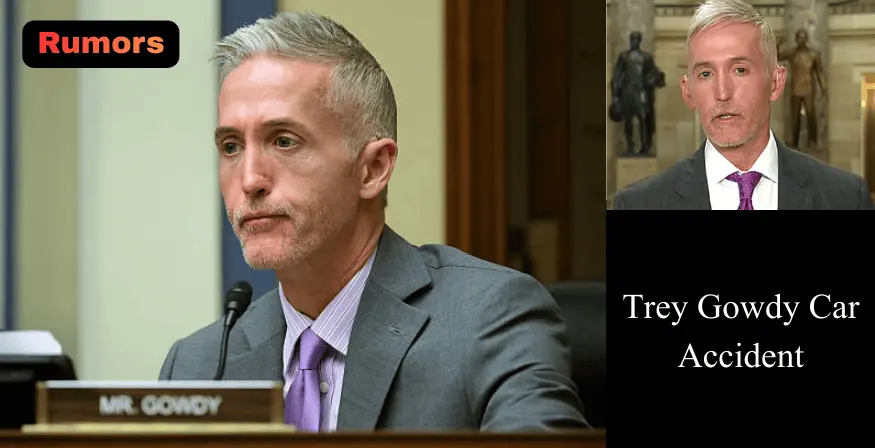
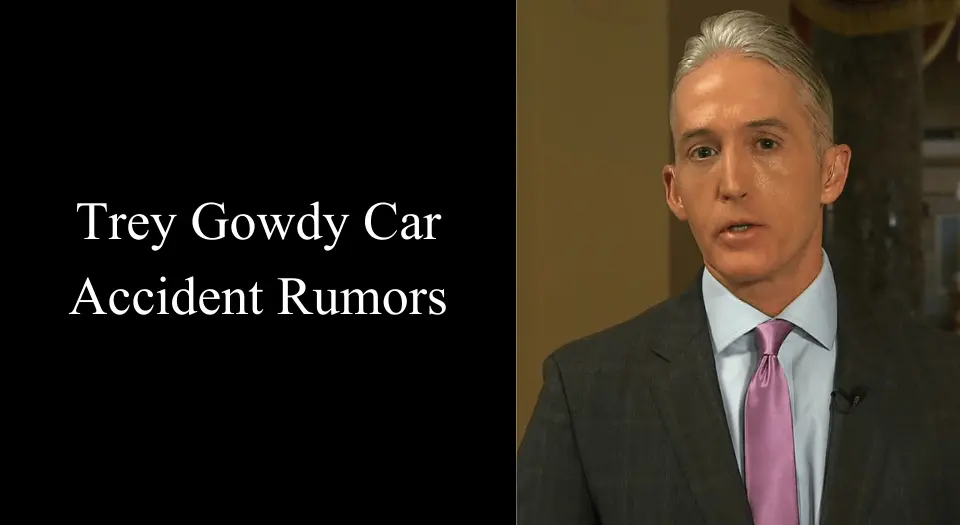
The core of the rumor is specific and gruesome. Online threads and clickbait articles claim Gowdy was in a severe wreck that smashed his face. The story suggests he underwent extensive facial reconstruction surgery to repair the damage.
Supporters of this theory point to his nose and forehead. They claim his nose looks thinner or that his forehead shows signs of scarring. Some versions of the story even allege he was in a coma or that he nearly died. It is a dramatic narrative that explains why he looks different today compared to his Congressional photos from 2015.
Timeline: When Did the Speculation Start?
Interestingly, this rumor isn’t tied to a specific date. You won’t find a breaking news alert from 2023 announcing a crash. Instead, search trends show a slow burn.
The speculation began to spike in late 2023 and continued rising throughout 2024. This timing coincides with his increased airtime on Fox News. As high-definition cameras broadcast him into millions of living rooms every Sunday, viewers started noticing normal physical changes. Instead of attributing them to aging or lighting, the internet latched onto the idea of a catastrophic event.
Fact-Checking the Trey Gowdy Car Accident
Rumors can be stubborn, but facts are stubborn things too. When we move past the social media chatter and look for hard evidence, the case for a car accident completely falls apart. We didn’t just look for news stories; we looked for the official paper trail that every serious accident leaves behind.
Investigating Police Records and Official Reports
In the United States, serious traffic collisions generate public records. If a prominent figure like a former Congressman was involved in a crash severe enough to crush his face, police would be involved. There would be an incident report, insurance filings, and likely a citation or investigation.
We checked the records. The South Carolina Highway Patrol, which monitors the state’s major roadways, has no record of a crash involving Trey Gowdy during the rumored timeline. Local law enforcement agencies in Charleston, Greenville, and Spartanburg—where he has lived and worked—are equally silent. There are no mugshots, no accident scene photos, and no docket numbers. In the legal world Gowdy comes from, if there is no documentation, it didn’t happen.
The Deafening Silence from Major Media
Consider the media landscape we live in today. When a celebrity or politician even stubs their toe, it often makes the news ticker. Trey Gowdy is a major asset for Fox News. If one of their primetime Sunday hosts was in a near-fatal wreck, the network would have issued a statement. They would have asked for prayers or explained his absence.
Instead, there has been absolute silence. Credible outlets like CNN, the Associated Press, and NBC have zero coverage of this alleged event. This silence isn’t a cover-up; it is proof of absence. Media outlets thrive on breaking news. They would not ignore a story this big if it were true. This phenomenon of “phantom news” is becoming more common, where audiences search for tragedies that simply never occurred, similar to the baseless confusion seen in the Al Michaels wife accident rumors, where internet speculation spiraled without a single verified report.
The Verdict from Fact-Checking Organizations
We aren’t the only ones looking into this. Professional fact-checking organizations like Snopes and PolitiFact exist to verify these exact types of viral claims. They have the resources to contact representatives and dig through hospital logs.
Their verdict is unanimous: the story is false. They classify the Trey Gowdy car accident as misinformation. When every watchdog organization independently reaches the same conclusion—that there is no evidence—it is time to put the rumor to rest.
Visual Analysis: Why People Think He Was in a Crash
If there was no accident, why are people so convinced? The answer lies in our eyes. Viewers have noticed changes in Gowdy’s face, and without a clear explanation, they invented one.
Deconstructing the “Forehead Mark” and Nose Changes
The primary driver of the rumor is a specific mark often seen on Gowdy’s forehead, coupled with a perceived thinning of his nose. On high-definition television, every pore and blemish is magnified.
Internet sleuths took screenshots of his forehead, circled a red spot, and declared it “impact trauma” from a steering wheel. In reality, skin blemishes, sun spots, or even simple irritations are common for everyone. Gowdy has fair skin and spent years campaigning outdoors in the South Carolina sun. What the internet calls a “scar from a wreck” is far more likely to be a common dermatological issue treated by a standard procedure.
Natural Aging vs. Trauma: A Realistic Explanation
We also have to be realistic about aging. Trey Gowdy is over 60 years old. He has lost weight since his days in the House of Representatives. When a person loses weight, specifically in their face, the skin becomes less taut, and bone structure becomes more defined.
The “hollowed” look that conspiracy theorists attribute to reconstructive surgery is actually consistent with natural aging and weight loss. Furthermore, studio lighting is deceptive. The harsh lights of a TV set can cast shadows that change the shape of a nose or cheekbones. Comparing a candid photo from 2015 to a professionally lit broadcast in 2024 is not a fair comparison; it is an optical illusion.
Addressing the Plastic Surgery and Skin Cancer Theories
In the absence of an accident, other theories have popped up. Some speculate he had skin cancer (Basal Cell Carcinoma) removed from his nose or forehead. While Gowdy hasn’t confirmed this, it is a plausible medical explanation that aligns with the visual evidence. Mohs surgery, a common treatment for skin cancer, can leave small scars or change skin texture. This is a medical routine, not a vehicular tragedy.
The Real Danger: The 2012 Church Parking Lot Incident
Ironically, Trey Gowdy was involved in a dangerous incident involving a vehicle, but it wasn’t a crash. It is possible that the “car accident” rumor is a twisted memory of this real event.
In 2012, while waiting for his daughter in a church parking lot in Spartanburg, a woman approached Gowdy’s car. She pulled a gun and tapped it on his window. It was a terrifying, life-threatening moment. Gowdy remained calm, drove away, and called the police. The woman was later arrested.
This story is verified. It is in police records. It was covered by the news. It shows that when real danger happens to Trey Gowdy, it is documented and reported. The contrast between this confirmed gun incident and the fake car accident highlights just how baseless the current rumors are.
How Digital Misinformation Fueled the Myth
The Trey Gowdy story didn’t spread by accident. It was pushed by the mechanics of the modern internet. To understand why this rumor won’t die, we have to look at the “content farms” that keep it alive.
The Role of Content Farms and AI Journalism
There is a whole industry built on clicking. “Content farms” are low-quality websites that identify trending search terms—like “Trey Gowdy accident”—and churn out articles to capture that traffic. These sites often use Artificial Intelligence to write hundreds of stories a day. The AI scrapes the web for keywords, finds a forum post speculating about a crash, and rewrites it as a “news report.”
This creates a feedback loop. One site publishes a fake story. A second site cites the first site. Suddenly, it looks like multiple sources are reporting the same event. In reality, it is just an echo chamber of fabricated information designed to show you ads.
YouTube Thumbnails and the Clickbait Cycle
Visuals are even more powerful than text. If you search for Trey Gowdy on YouTube, you will likely see thumbnails with red arrows pointing to his forehead, or doctored images making him look injured. These creators know that a dramatic, tragic image gets more clicks than a boring, truthful one.
These thumbnails bypass our critical thinking. We see the image and our brain registers “injury” before we even click the video. Even if the video content doesn’t actually show an accident, the seed is planted. This is visual clickbait, and it is the primary engine behind the rumor’s longevity.
The Psychology of Belief: Why We Fall for Hoaxes
Why do we believe these stories? Psychologists call it the “Availability Heuristic.” When we see a piece of information repeatedly—in headlines, thumbnails, and tweets—our brains start to treat it as true simply because it is familiar.
We also have a natural curiosity about the hidden lives of public figures. We want to believe there is a secret story that “they” don’t want us to know. Believing in a secret accident feels like having insider knowledge. It turns a boring reality (aging and lighting) into a compelling mystery.
A Pattern of Celebrity Accident Hoaxes
Trey Gowdy is not the first victim of this digital phenomenon, and he won’t be the last. The internet has a strange habit of inventing car accidents for celebrities. It follows a predictable script: take a celebrity who hasn’t been seen in a while, add a vague rumor of a crash, and watch the search traffic explode.
This pattern is global. We saw a nearly identical situation with the rumors surrounding the Martin Clunes wife accident. In that case, just like with Gowdy, internet users aggressively searched for details of a tragedy that never occurred, proving that whether the subject is a British actor or an American politician, the public’s appetite for “secret tragedy” remains a constant driver of misinformation. These stories thrive because they are impossible to disprove immediately; the silence of the celebrity is interpreted as proof of a cover-up rather than proof that nothing happened.
FAQs
No. There are no police reports, medical records, or credible news stories to support this claim. The rumor is entirely false.
The changes in his appearance are due to natural aging, weight loss, and the harsh lighting of television studios. He is in his 60s, and facial features naturally change over time.
No. If a prominent host had been injured, the network would have addressed it. The absence of a report from Fox News is evidence that no accident occurred.
There is no verified evidence that he is battling a serious illness. He maintains a busy work schedule, appears on television weekly, and hosts a regular podcast.
Conclusion
The internet is a powerful tool, but it is also a rumor mill. The story of the Trey Gowdy car accident is a perfect case study in how misinformation spreads. It started with innocent observations about his appearance, was amplified by social media speculation, and was monetized by content farms.
The facts are clear: Trey Gowdy was not in a car accident. He was not hospitalized for facial reconstruction, and there is no media cover-up. He is simply a public figure growing older in the spotlight.
The next time you see a shocking headline about a celebrity tragedy that no major news outlet is reporting, pause before you click. In the case of Trey Gowdy, the only thing that crashed was the truth.