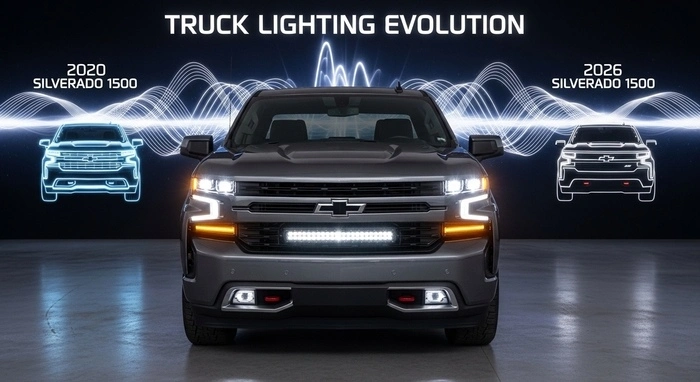
The Ultimate Guide to Truck Lighting Evolution: Optimizing the 2020-2026 Silverado 1500
Introduction: The Invisible Safety Hazard
Automotive engineering has seen a radical transformation in the last decade, with engines becoming more efficient and cabins more luxurious. However, a silent gap remains in the lighting department for many pickup trucks. Despite the Chevrolet Silverado’s legendary status, the factory-standard halogen setups in many trims often fail to meet the demands of modern high-speed night driving.
For the discerning owner, the transition to auto car led lights is no longer a mere aesthetic trend; it is a critical safety recalibration. When we talk about “visibility,” we aren’t just discussing how far you can see—we are discussing how much time you have to react to a hazard at 70 mph.
Understanding the 2020-2026 Silverado 1500 Lighting Architecture
The T1 platform (which encompasses the 2020-2026 models) presents a unique set of challenges for aftermarket lighting. Unlike older trucks with wide-open engine bays and simple wiring, the newer Silverado 1500 is a sophisticated piece of electrical engineering.
Selecting 2019-2026 Silverado 1500 LED headlights requires a deep understanding of the vehicle’s Pulse Width Modulation (PWM) system. The truck’s ECU sends rapid electrical pulses to the bulbs rather than a constant stream of power. This is why low-quality LED kits often flicker or fail prematurely. A high-performance upgrade must include an integrated “CANBUS Decoded” driver that can smooth out these pulses, ensuring a steady, flicker-free output that won’t interfere with the truck’s delicate onboard sensors or radio frequencies.
The Science of the “Sharp Cutoff Line”
One of the most debated topics in automotive forums is the “blinding” effect of LED upgrades. This is not a fault of the LED technology itself, but rather a failure of optical alignment.
When you install auto car LED lights, the goal is to replicate the focal point of the original halogen filament down to the millimeter. In the 2020-2026 Silverado 1500 led headlights housings—especially the reflector-style lamps found on WT and Custom trims—this precision is paramount.
- The 3:9 Orientation: The LED chips must face exactly 3 o’clock and 9 o’clock.
- The Cutoff Effect: Proper alignment produces a “cutoff line” that keeps the light concentrated below the eye level of oncoming drivers while extending the “throw” of the beam hundreds of feet further down the road. This is the difference between a “street-legal” feel and becoming a hazard to others
Thermal Dynamics in Sealed Housings
Heat is the primary enemy of LED longevity. While a halogen bulb uses heat to create light, an LED creates light through electrons moving through a semiconductor, a process that creates localized heat at the “junction.”
For a truck that might spend hours on the highway during a summer heatwave, thermal management is a non-negotiable feature. Top-tier 2020-2026 Silverado 1500 led headlights utilize a multi-stage cooling ecosystem:
- Liquid-Cooled Copper Substrates: These act as a “heat highway,” whisking thermal energy away from the LED chips instantly.
- 6063 Aviation Aluminum Heat Sinks: These provide the surface area needed for dissipation.
- Intelligent Temperature Control (ITC): Modern drivers now include sensors that automatically adjust power if the bulb detects an overheat situation, protecting your truck’s factory wiring from thermal damage.
Weather Resistance and Field Durability
Trucks are built for the elements, and their lighting should be no different. Whether you are dealing with a North Dakota blizzard or a Florida thunderstorm, your auto car LED lights must be sealed against moisture and dust.
Look for an IP67 or IP68 rating. This ensures that the high-speed cooling fan and the electrical connections can withstand total immersion in water. For the Silverado 1500, which often sees use on construction sites or off-road trails, the vibration resistance of the LED’s internal components is equally important. Unlike halogens, which have a fragile wire filament that can snap on a bumpy road, LEDs are “solid-state” devices, making them nearly immune to the shocks and vibrations of off-road adventuring.
The ROI of High-Quality Lighting
Beyond safety, there is a clear economic argument for upgrading. A standard halogen bulb has a lifespan of roughly 500 to 1,000 hours. In contrast, a well-engineered LED system is rated for 30,000 to 50,000 hours.
For a 2020-2026 Silverado owner, this means the 2020-2026 Silverado 1500 LED headlights you install today will likely outlast your ownership of the truck. You are trading frequent, dim replacements for a one-time, high-performance investment. Furthermore, the 6000K “Cool White” light doesn’t just look better; it significantly enhances the resale value and modern appeal of the vehicle.
Conclusion: Future-Proofing Your Truck
As we look toward the future of automotive technology, the integration of high-efficiency electronics is inevitable. By choosing premium auto car LED lights now, you are effectively future-proofing your vehicle’s safety systems.
For the specific needs of the 2020-2026 Silverado 1500 led headlights, the key is to prioritize “Application-Specific” engineering. Don’t settle for universal kits that require hacking your dust covers or splicing your wires. Demand a solution that respects the craftsmanship of your Chevrolet while providing the daylight-level clarity that every truck owner deserves.