Why Outdated U.S. Roads Increase the Risk of Car Crashes
Across the United States, drivers, cyclists, and pedestrians are dealing with the same growing problem: roads that no longer match modern traffic demands. Crumbling pavement, worn lane markings, poor lighting, outdated intersections, and road layouts built for a different time all make travel less safe. What may seem like a simple inconvenience, such as a pothole or a hard-to-read sign, can quickly become the cause of a serious collision.
America’s transportation network is showing its age, and that aging infrastructure has real safety consequences. When roads are not properly maintained or updated, they create conditions that make mistakes more likely and crashes more severe. Understanding this connection is important not only for public safety but also for recognizing why infrastructure investment matters.
Roads Designed Decades Ago Are Serving Today’s Traffic
A large share of the nation’s highways and roadways was built in the middle of the twentieth century, during a period of rapid suburban growth and interstate expansion. Those systems were groundbreaking at the time, but they were designed for a country with far fewer people, fewer cars, and very different driving habits.
Today, the United States has a much larger population and significantly more vehicles on the road than it did when much of this infrastructure was first built. At the same time, vehicles themselves have changed. Many are wider, heavier, and faster than the cars those roads were designed to handle. Commercial trucking has also increased, placing more strain on pavement and bridges while adding larger vehicles to roadways that may not be suited for them.
The result is a growing mismatch between yesterday’s design standards and today’s transportation reality. Roads that once functioned well may now be overcrowded, deteriorated, or simply outdated. That mismatch raises the likelihood of collisions because infrastructure affects how people drive, how traffic flows, and what happens when someone makes an error.
Poor Maintenance Creates Immediate Hazards
Aging infrastructure is not just about old design. It is also about delayed repairs and long-term neglect. When roadways are not maintained, dangers emerge that can directly trigger crashes.
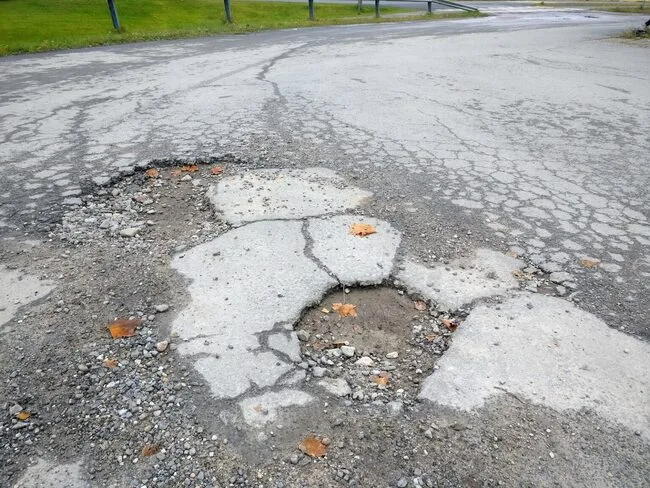
Potholes are among the clearest examples. They can damage tires, throw off steering, or cause drivers to swerve unexpectedly into neighboring lanes. Eroded shoulders are another serious problem, especially on rural roads, where a driver who drifts off the pavement may have little room to recover safely. Faded lane lines and worn signs reduce visibility, making it harder for motorists to judge their position or react in time, particularly at night or during rain.
Water management is another overlooked issue. If drainage systems fail, standing water can build up on the roadway and increase the risk of hydroplaning. Debris left on roads can force sudden braking or evasive moves that lead to chain-reaction crashes. Even overgrown vegetation can become dangerous if it blocks stop signs, signals, or sight lines near curves and intersections.
Broken or insufficient street lighting also contributes to collisions by reducing visibility for drivers and making pedestrians harder to see. In busy areas, a poorly lit crosswalk or intersection can turn an already risky location into a dangerous one.
Outdated Design Can Be Just as Dangerous as Poor Repairs
Even when pavement is in decent shape, older road design can still create unsafe conditions. Many roads were built before modern traffic volumes, distracted driving, and the current mix of vehicle sizes became common. As a result, design features that once seemed acceptable may now increase crash risk.
Narrow travel lanes are one example. They leave less room for error, especially when larger SUVs, delivery vans, and trucks share the road. Older interchanges, including cloverleaf ramps, can confuse drivers and create merging conflicts. Long straight stretches of road may encourage speeding or inattentive driving, especially when the environment provides little visual feedback to slow down.
Some roads lack medians or barriers separating opposite directions of travel, increasing the possibility of head-on collisions. Others were built with little consideration for pedestrians or cyclists, offering no refuge islands, dedicated bike lanes, safe crossings, or sidewalks. In many places, highways and arterial roads cut directly through communities without safe ways for residents to cross them on foot.
These flaws are not merely inconvenient. They create conditions where routine driving errors are more likely to end in serious injuries.
Some Communities Face Greater Risk Than Others
The dangers tied to aging infrastructure do not appear in the same way everywhere. Rural, urban, and suburban areas each face different problems.
On rural roads, drivers often deal with narrow lanes, missing shoulders, weak lighting, and limited signage. Crashes in these areas are often more severe because speeds tend to be higher and emergency response times longer. Rural roads may also go years without meaningful upgrades, allowing hazards such as failing guardrails, broken pavement edges, and poor reflectivity to remain in place.
In cities, the challenge is often congestion combined with outdated street design. Overloaded intersections, hard-to-read lane patterns, faded markings, and insufficient pedestrian protections all increase the chance of collisions. Drivers, cyclists, buses, and pedestrians are forced to share spaces that were never redesigned for the current traffic intensity.
Suburban communities face a different issue: roads originally intended for light neighborhood use are now major commuter corridors. These wide roads often encourage higher speeds but still run through residential zones with limited sidewalks, crosswalks, or traffic-calming features. That combination creates danger for both motorists and people outside vehicles.
Safer Infrastructure Can Prevent Crashes
Driver behavior certainly plays a major role in traffic accidents, but infrastructure shapes the outcome of those behaviors. Good road design helps prevent mistakes from becoming tragedies. Just as modern vehicles include safety systems to reduce human error, roads can be engineered to do the same.
Updated traffic signals that respond to real-time traffic conditions can improve flow and reduce conflicts. Roundabouts can lower the likelihood of severe intersection crashes. Protected bike lanes, pedestrian barriers, wider edge lines, better lighting, and dedicated turn lanes all help reduce collision risk. Even small design changes can save lives when they are based on how people actually move through roadways.
Safer roads are not about making driving easier for careless motorists. They are about creating a transportation system that recognizes human limitations and better protects everyone who uses it.
Legal Responsibility and the Bigger Picture
In some situations, a crash caused by dangerous road conditions may lead to a legal claim against a government agency, contractor, or property owner. These cases are often more complicated than ordinary accident claims because they involve special procedures, strict deadlines, and the challenge of proving that poor infrastructure contributed to the collision. Consulting a reputable car accident attorney is critical in such cases.
Still, the broader point remains clear: many crashes linked to deteriorating or outdated roads are preventable. America’s road network was not built for the pressures of the twenty-first century, and failing to modernize it comes with serious human costs. Investing in safer, smarter infrastructure is not optional. It is one of the most important ways to reduce injuries, save lives, and make travel safer for everyone.