SUVs Without CVT Transmission: Top Picks for Durability, Towing, and Performance
You press the gas pedal to merge onto the highway, expecting a surge of power. Instead, you hear a loud drone from the engine, but the car feels like it’s struggling to catch up. This is the infamous “rubber-band effect,” a common complaint among drivers of vehicles equipped with Continuously Variable Transmissions (CVTs). While manufacturers love CVTs for their ability to squeeze out every drop of fuel efficiency, many drivers find them lacking in engagement, durability, and towing capability.
If you miss the feeling of a distinct gear shift or need a vehicle that can handle heavy loads without overheating, you are not alone. There is a strong market for SUVs that stick to traditional engineering. This guide focuses on SUVs equipped with reliable torque-converter automatic transmissions, dual-clutch systems, and manual gearboxes. We will explore why these vehicles are often the better choice for towing, off-roading, and long-term peace of mind.
Engineering Analysis: CVT vs. Traditional Transmissions
To understand why so many drivers are returning to traditional transmissions, we first need to look at what is happening under the hood. The difference isn’t just in how the car feels; it is about how the power reaches the wheels.
How Continuously Variable Transmissions (CVT) Work
A CVT does not use gears in the traditional sense. Instead, it relies on a system of belts and pulleys that change diameter to offer an infinite number of gear ratios. The computer constantly adjusts these pulleys to keep the engine in its most efficient RPM range. While this is great for fuel economy on paper, it often disconnects the driver from the road. The engine speed doesn’t match the vehicle speed, creating that slipping sensation many drivers dislike.
The Mechanics of Traditional Gearboxes
In contrast, a traditional automatic transmission (like a 6-speed, 8-speed, or 10-speed) uses a complex set of planetary gears and a torque converter. When you accelerate, the transmission physically shifts from one gear to the next. You feel a satisfying drop in RPMs as the car gains speed. This design allows for better management of engine torque, which is crucial for quick acceleration and climbing hills.
It is a common myth that you have to choose a CVT to get good fuel economy. Modern engineering has closed that gap significantly. You can easily find a midsize SUV with best gas mileage that still utilizes a traditional automatic transmission, giving you the best of both worlds: efficiency and driving pleasure.
Comparison: CVT vs. Traditional Automatic
| Feature | CVT | Traditional Automatic |
| Driving Feel | Smooth but disconnected (Drone/Whine) | Engaging with distinct shift points |
| Towing | Low capacity, prone to overheating | High capacity, stable under load |
| Durability | Belt wear can be an issue over time | Proven longevity with fluid changes |
| Maintenance | Costly unit replacement if failed | Easier to repair individual solenoids |
Why Drivers Prefer SUVs Without CVT: Key Advantages
Choosing an SUV with a fixed-gear transmission isn’t just about nostalgia; it is a practical decision based on performance and utility.
Superior Towing and Hauling Capabilities
If you plan to tow a boat, camper, or trailer, a traditional transmission is almost non-negotiable. Fixed gears allow you to lock the transmission into a specific range, preventing it from “hunting” or overheating while pulling a heavy load up a grade. CVTs rely on friction between the belt and pulley, which can slip under extreme stress, leading to potential failure.
Enhanced Off-Road Performance
For off-road enthusiasts, control is everything. When navigating mud, rocks, or steep inclines, you need low-end torque. A traditional automatic or manual transmission allows you to hold a low gear, keeping the power delivery steady. This prevents the surge-and-lag behavior of a CVT that can cause tires to spin unpredictably on loose terrain.
The “Connected” Driving Experience
For many, driving is more than just transportation. A standard automatic transmission eliminates the lag often felt in CVTs. When you step on the gas, the transmission downshifts instantly, placing the engine in the power band you need. This responsiveness makes merging, passing, and spirited driving much more confident and enjoyable.
Long-Term Reliability and Repair Costs
History has shown that torque-converter automatics are incredibly durable. Many can last hundreds of thousands of miles with simple fluid changes. In contrast, CVTs are often “sealed units,” meaning if the internal belt or chain breaks, you frequently have to replace the entire transmission, which is a significant expense.
Top Rated SUVs Without CVT Transmission
Now that we understand the mechanical advantages, the next step is finding the right vehicle. Fortunately, the market is still full of exceptional SUVs that rely on proven transmission technologies. We have categorized them by their primary strengths to help you navigate your options.
Rugged Off-Roaders & Adventure Vehicles
For drivers who spend their weekends on the trails or navigating rough terrain, a robust transmission is essential. These vehicles prioritize torque and control over smooth city cruising.
Ford Bronco
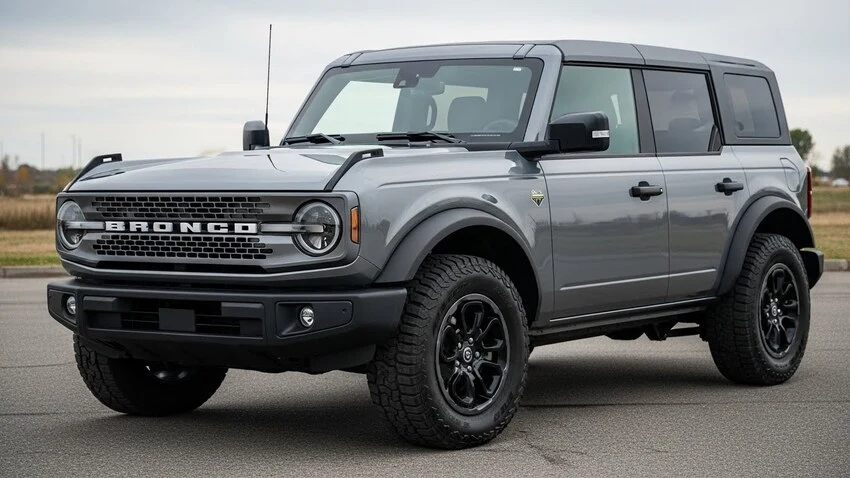
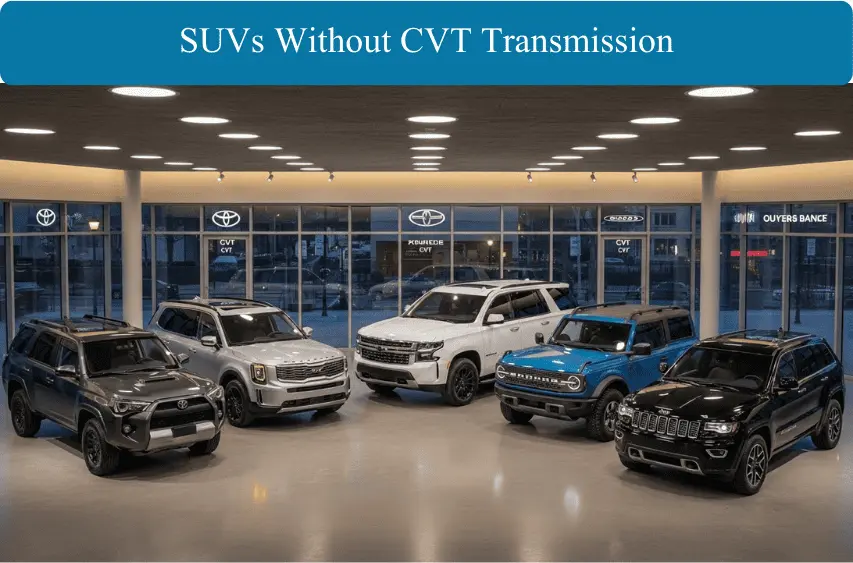
The Ford Bronco has made a massive comeback, directly targeting enthusiasts who want control. It features a tough 10-speed automatic transmission that optimizes power delivery across a wide range of speeds. For purists, there is also a 7-speed manual option with a dedicated crawler gear. This setup pairs perfectly with its G.O.A.T. (Go Over Any Terrain) modes, ensuring you have the right gear for mud, sand, or rocks.
Jeep Wrangler
The Wrangler remains the gold standard for off-road capability. It offers an 8-speed automatic transmission that is widely praised for its smooth shifting and reliability. Whether crawling over boulders or accelerating on the highway, the transmission holds gears intelligently to maintain momentum.
Mercedes-Benz G-Class
At the top of the luxury food chain sits the G-Class. It combines a powerful V8 engine with a traditional 9-speed automatic transmission. This vehicle is built like a fortress, offering unmatched durability and safety. If you are drawn to this robust, boxy aesthetic and want a vehicle that prioritizes safety and road presence, you might be interested in a car that looks like a tank. These types of vehicles offer a commanding view of the road and a level of structural integrity that few crossovers can match.
Reliable Family Haulers (Compact & Midsize)
You do not need to buy a massive off-roader to avoid a CVT. Several practical, family-friendly SUVs still use traditional automatic gearboxes to ensure a quiet and responsive daily drive.
Toyota RAV4
The Toyota RAV4 is one of the best-selling vehicles in the world, and its transmission plays a big role in that success. Unlike many of its competitors that have switched to CVTs, the gas-powered RAV4 sticks with a direct-shift 8-speed automatic. This gives it a snappy, responsive feel when pulling away from stoplights, making it a favorite for city driving.
Mazda CX-5
Mazda focuses heavily on driving dynamics, which is why it refuses to put a CVT in the CX-5. Instead, it uses a quick-shifting 6-speed automatic transmission. While it has fewer gears than some rivals, the programming is excellent, holding gears during spirited driving to keep the engine in its power band. This makes the CX-5 feel significantly more premium and sporty than other compact SUVs.
Hyundai Tucson & Kia Sportage
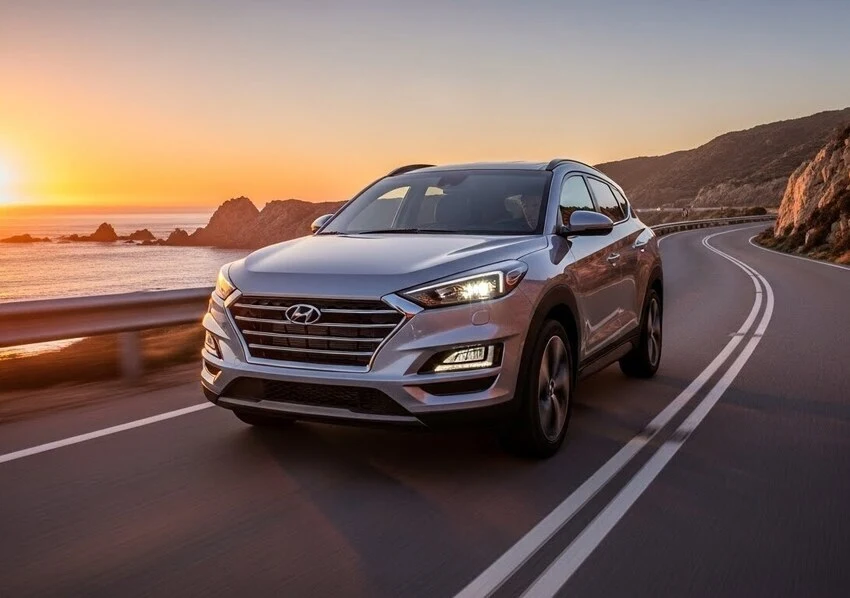
Both of these Korean cousins offer excellent value and reliability. According to recent model specs, the Hyundai Tucson utilizes a smooth 6-speed automatic, while the Kia Sportage often features an 8-speed automatic depending on the trim. These transmissions provide a familiar driving feel without the drone associated with CVTs, making them solid choices for road trips and commuting.
Full-Size & Performance SUVs
When you need to carry more passengers or crave high-performance driving, traditional transmissions are the standard.
Toyota 4Runner & Highlander
Toyota offers two distinct flavors here. The 4Runner is a body-on-frame beast using a legendary 5-speed automatic. It is old-school technology, but it is virtually indestructible. On the other hand, the Highlander is a unibody family SUV with a refined 8-speed automatic, offering a smoother ride for school runs and grocery trips while still maintaining decent towing capability.
Dodge Durango
If towing is your priority, the Dodge Durango is a standout. Paired with a standard 8-speed automatic, it manages the power of its V6 or V8 engines effortlessly. This setup allows for impressive towing capacities, easily handling boats or heavy campers that would strain a CVT-equipped crossover.
Critical Buying Factors: Selecting the Right Non-CVT SUV
Choosing the right SUV goes beyond just checking the transmission type. You need to align the vehicle’s engineering with your lifestyle to ensure you get the most value out of your purchase.
Assessing Your Driving Habits
First, ask yourself what your daily drive looks like. If you spend 90% of your time in stop-and-go city traffic, a CVT is tolerable, but a traditional automatic is still superior for longevity. However, if your routine involves highway commuting, towing a trailer, or weekend trail driving, a non-CVT SUV is essential. The ability to hold a gear on a steep highway grade or while descending a mountain pass provides a level of safety and control that CVTs simply cannot match.
Budgeting for Maintenance and Fuel
It is true that traditional automatics might yield 1 or 2 fewer miles per gallon compared to a CVT. However, you must look at the total cost of ownership. The fuel savings of a CVT can be quickly wiped out by a single transmission replacement, which can cost thousands of dollars. Reliability should always be your top priority. Even when shopping for premium SUVs with robust gearboxes, research is vital. For example, knowing the Mercedes GLK years to avoid can save you from buying a model with known mechanical gremlins, proving that diligence is key regardless of the brand.
Resale Value Considerations
Vehicles with traditional transmissions often hold their value better, especially in the used market. Enthusiasts and mechanics prefer them because they are easier to work on and generally last longer. An old 4Runner or Wrangler with a standard automatic transmission will command a high price years down the road, whereas an older crossover with a high-mileage CVT is often viewed as a ticking time bomb by buyers.
Maintenance Tips for Maximizing Gearbox Lifespan
Even the toughest transmission needs care. Follow these simple steps to ensure your SUV runs smoothly for hundreds of thousands of miles.
Fluid Management
Transmission fluid (ATF) is the lifeblood of your gearbox. Unlike engine oil, it doesn’t just lubricate; it acts as hydraulic fluid to shift gears. Most manufacturers claim the fluid is “lifetime,” but mechanics agree that changing it every 60,000 miles is smart insurance against wear.
Warm-Up Protocols
Allow your vehicle to idle for 30 to 60 seconds before shifting out of Park, especially on cold mornings. This gives the transmission pump time to circulate oil throughout the valve body, ensuring that the first shift of the day is protected and smooth.
Leak Detection
Get in the habit of glancing under your SUV. Transmission fluid is typically bright red. If you see reddish drops on your driveway, address the seal or gasket issue immediately. Running a transmission low on fluid is the fastest way to destroy it.
The Future of the Gearbox: Are Traditional Automatics Disappearing?
While CVTs dominate the economy car segment, the traditional automatic is far from dead. In fact, it is evolving. We are now seeing 9 and 10-speed automatic transmissions that offer fuel efficiency rivaling CVTs while keeping the driving engagement intact. Furthermore, some manufacturers are moving back to automatics for their hybrid powertrains (like Toyota’s new Hybrid MAX system) to provide the torque and driving feel that customers demand.
Conclusion
The debate between CVT and non-CVT comes down to what you value most. If you view a car merely as an appliance to save gas, a CVT is fine. But if you value durability, towing capability, and a connected driving experience, an SUV without a CVT is the clear winner. By choosing a model like the RAV4, Bronco, or 4Runner, you are investing in a vehicle built for the long haul.
FAQs
The gas-powered Toyota RAV4, Toyota Highlander, Toyota 4Runner, Toyota Sequoia, and Toyota Land Cruiser all use traditional automatic transmissions.
Generally, yes. CVTs are often replaced as a single sealed unit because internal parts are not serviceable, whereas a traditional automatic can often be repaired by replacing solenoids or clutch packs.
No. CVTs struggle with low-speed torque delivery needed for rock crawling or mud. A traditional transmission allows you to hold a low gear for better traction and control.
Top picks for 2025 include the Ford Bronco, Jeep Wrangler, Mazda CX-50, and the updated Toyota 4Runner.