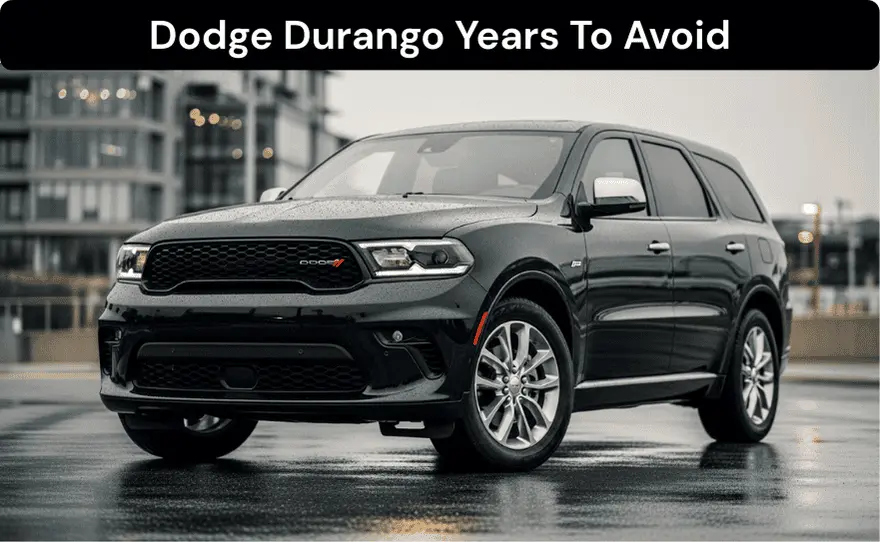
Dodge Durango Years To Avoid: Complete Reliability Guide
The Dodge Durango offers an appealing mix of family-friendly space and serious V8 towing capacity. Since 1998, this mid-size SUV has been a top choice for buyers who need three rows of seating without sacrificing performance. But if you are shopping for a used Dodge Durango, you need to tread carefully.
Not all model years offer the same reliability. Buying the wrong year can leave you stranded with catastrophic engine failures or maddening electrical gremlins. Let’s break down exactly which Dodge Durango years to avoid, the common problems you will face, and which years are actually safe to buy.
Dodge Durango Years to Avoid (Quick Answer)
If you want the short version, steer clear of the 1999–2000, 2004–2005, and 2011–2014 Dodge Durango model years. These specific production runs suffer from the highest volume of NHTSA complaints. Owners consistently report frequent engine stalling, total transmission failures, and expensive electrical faults that cost thousands of dollars to fix.
Dodge Durango Generations Overview
To understand why certain models fail, you first need to look at how Dodge built them. The Durango went through three major redesigns, changing platforms and powertrain options along the way.
First Generation (1998-2003)
Dodge originally built the Durango on the same body-on-frame platform as the Dodge Dakota pickup truck. This design gave the early SUV rugged, truck-like capabilities and excellent towing power. However, it also meant the ride felt rough, the interior was cramped, and fuel efficiency was notoriously poor.
Second Generation (2004-2009)
The second generation grew significantly in size. Dodge wanted to compete directly with full-size SUVs, so they gave the Durango a larger footprint and introduced the legendary 5.7L Hemi V8 engine. While it offered more power and a smoother ride, the early years of this generation suffered from severe growing pains and mechanical defects.
Third Generation (2011-Present)
For the 2011 model year, Dodge completely transformed the Durango. They ditched the old truck frame and moved to a highly refined unibody platform. Because it shares this exact architecture and electrical foundation with another popular Stellantis SUV, buyers cross-shopping these vehicles often check the Jeep Grand Cherokee years to avoid to better understand their shared vulnerabilities.
Complete List of Dodge Durango Years to Avoid
Now that you know the timeline, let’s look at the specific model years that generate the most headaches. We base this data on historical recall volumes, technical service bulletins, and actual owner complaints.
1999–2000 Dodge Durango Problems (First Gen)
The 1999 and 2000 models are easily some of the worst vehicles Dodge produced during that era. Chronic front suspension failures constantly plague these early SUVs. The upper ball joints and wheel hub assemblies wear out prematurely. In worst-case scenarios, this defect can literally cause the wheels to separate from the vehicle while driving.
Beyond the dangerous suspension, the 5.2L Magnum V8 engine is highly prone to sudden stalling. Faulty Powertrain Control Modules (PCM) and failing crank sensors shut the engine off at highway speeds, instantly disabling your power steering and brakes without any warning.
2004–2005 Dodge Durango Problems (Early Second Gen)
You might think a newer generation means better reliability, but the 2004 and 2005 models prove otherwise. The 2004 Dodge Durango is infamous for total engine failure. Internal oil sludge builds up rapidly, destroying the engine from the inside out and leaving owners with complete replacement bills averaging well over $5,000.
The 2005 model year shifted the focus to terrifying fuel system defects. A faulty check valve in the fuel tank filler tube caused gasoline to splash out heavily during refueling. This massive fire hazard forced Dodge to issue multiple recalls, but the issue still frustrates many used car buyers today who discover the fix was never properly applied.
2011–2014 Dodge Durango Problems (Early Third Gen)
The early unibody Durangos look modern and drive beautifully, but their electrical systems are a nightmare. Between 2011 and 2013, the Totally Integrated Power Module (TIPM) failed at an alarming rate. This module acts as the SUV’s electrical brain. When it fails, the fuel pump relay dies. This causes the engine to stall in traffic, the alternator to burn out, and the battery to drain overnight.
By 2014, Dodge addressed the TIPM but introduced a new 8-speed automatic transmission that suffered from severe software glitches. Drivers reported hard shifting, slipping gears, and a jarring ride. Additionally, the 2014 model’s signature “racetrack” LED taillights often leaked water due to poor factory seals, causing the expensive housing to short out and fail completely.
Common Problems Found in Dodge Durango Bad Years
When you look closely at the Dodge Durango years to avoid, several mechanical patterns emerge. Knowing these common failure points helps you inspect a used vehicle more effectively and protects your wallet from surprise mechanic bills.

Engine and Transmission Issues
Powertrain failures are the most expensive repairs you will face. Early models frequently suffer from sudden engine stalling, engine misfires, and catastrophic internal oil sludge. On the transmission side, buyers frequently report hard shifting, delayed gear engagement, and slipping gears, which often require a full transmission rebuild.
Electrical and Technology Issues
Modern Durangos pack a lot of tech, but the early third-generation models struggle to manage it. The dreaded TIPM failure causes continuous dashboard warning lights, dead batteries, and sudden power loss. Even the Uconnect infotainment system in these bad years tends to freeze, reboot randomly, or drain power while the SUV sits parked.
Suspension and Steering Problems
A heavy SUV puts massive stress on its suspension. The 1999 and 2000 models, notorious for front suspension collapse, are prime examples. Listen closely for clunking noises over bumps, check for uneven tire wear, and feel for steering wheel vibration. These symptoms point to worn ball joints and failing tie rods.
HVAC and Exhaust Manifold Problems
If you opt for the 5.7L Hemi V8, listen for a distinct ticking noise during a cold start. This “Hemi tick” usually means the exhaust manifold bolts have snapped due to thermal expansion. Inside the cabin, a failing blend door actuator will trap your climate control on a single temperature, forcing mechanics to remove the entire dashboard to fix a cheap plastic gear.
Safety Defects: Airbags and Headrests
Safety should never take a backseat. Some 2013 and 2014 models feature active headrests that deploy or literally “explode” forward without any impact, risking serious injury. Other years suffered from frontal airbags that completely failed to deploy during collisions.
Dodge Durango Best Years To Buy
Fortunately, Dodge fixed many of these design flaws over time. If you want a dependable family hauler, several model years stand out for their strong reliability ratings and low complaint volumes.
2001-2003 Dodge Durango (First Gen Refinement)
If you have a tight budget and want a rugged, truck-based 4×4, look at the late first-generation models. Dodge sorted out the dangerous suspension flaws by 2001. These SUVs offer simpler mechanics and reliable V8 power, making them great, cheap workhorses.
2008 & 2017 Model Years
The 2008 model sits in a sweet spot for the second generation, boasting very few NHTSA complaints and solid engine reliability. Fast forward to the third generation, and the 2017 Durango earns fantastic J.D. Power reliability scores. By 2017, Dodge had completely resolved the TIPM electrical nightmares.
2020–2022 Dodge Durango Models
If you want modern safety features and peak refinement, buy a 2020, 2021, or 2022 model. These represent the best of the unibody platform. They feature the battle-tested 3.6L Pentastar V6, a bulletproof 8-speed transmission, and drastically lower long-term maintenance costs.
Used Dodge Durango Buying Tips and Ownership Costs
A smart purchase requires a thorough inspection. Never buy a used Dodge Durango on impulse, regardless of how clean the paint looks.
What to Check Before Buying
Always check the vehicle’s maintenance history. Run the VIN to ensure the dealer completed all TIPM and airbag recalls. Take a long test drive to feel how the transmission shifts between gears under heavy acceleration, and visually inspect the 2014+ “racetrack” taillights for trapped water condensation.
Dodge Durango Ownership Cost by Year
Your ownership costs heavily depend on the generation. Older V8 engines eat fuel and require frequent suspension upkeep. Conversely, later models carry higher insurance premiums but demand far fewer trips to the mechanic.
Is It Ever Okay to Buy a Dodge Durango From a Bad Year?
You can buy a “bad year” Durango only if the price is incredibly low and the previous owner has already paid for the major repairs. If a seller has paperwork proving a recent engine replacement and a new, upgraded TIPM module installation, that risky 2011 model suddenly becomes a viable bargain.
Where to Find a Great Dodge Durango
Skip the shady buy-here-pay-here lots. Focus on certified pre-owned dealership inventory for newer models. If you want a heavy-duty bargain, check government surplus auctions like Municibid, where fleet-maintained Durangos often sell below market value with perfect service records.
Dodge Durango Years to Avoid – Comparison Table
| Model Year | Generation | Major Problems | Verdict |
| 1999–2000 | First | Suspension collapse, engine stalling | Avoid |
| 2004–2005 | Second | Total engine failure, fuel system fire hazard | Avoid |
| 2011–2014 | Third | TIPM electrical faults, transmission slipping | Avoid |
| 2017 & 2020+ | Third | Very few reported issues | Best Buy |
FAQs
With strict preventative maintenance, a Dodge Durango will easily last over 200,000 miles. The newer third-generation models equipped with the V6 engine regularly push past 250,000 miles without requiring major powertrain rebuilds.
The 3.6-liter Pentastar V6 is undeniably the most reliable engine option. While the 5.7L Hemi V8 offers incredible towing torque and a great exhaust note, it suffers from the infamous manifold bolt ticking and consumes significantly more fuel.
Choose the GT trim for daily driving. It utilizes the reliable V6, saving you money at the gas pump while still offering aggressive styling. Choose the R/T trim only if you explicitly need V8 power for towing heavy boats or trailers.
The Durango wins easily for large families because it offers a functional third row and a longer wheelbase for better highway towing stability. However, the Durango sits lower to the ground. If your weekend plans involve serious rock crawling or deep mud, you are better off looking into a dedicated 4×4 platform; just be sure to research the Jeep Wrangler years to avoid before making that leap.
Conclusion
The Dodge Durango is a fantastic, muscular family SUV that gets the job done. However, your ownership experience directly depends on the year you choose. Avoid the 1999–2000, 2004–2005, and 2011–2014 models to dodge catastrophic repair bills. Stick to the refined later years, demand thorough service records, and you will drive away with a highly capable, dependable vehicle.