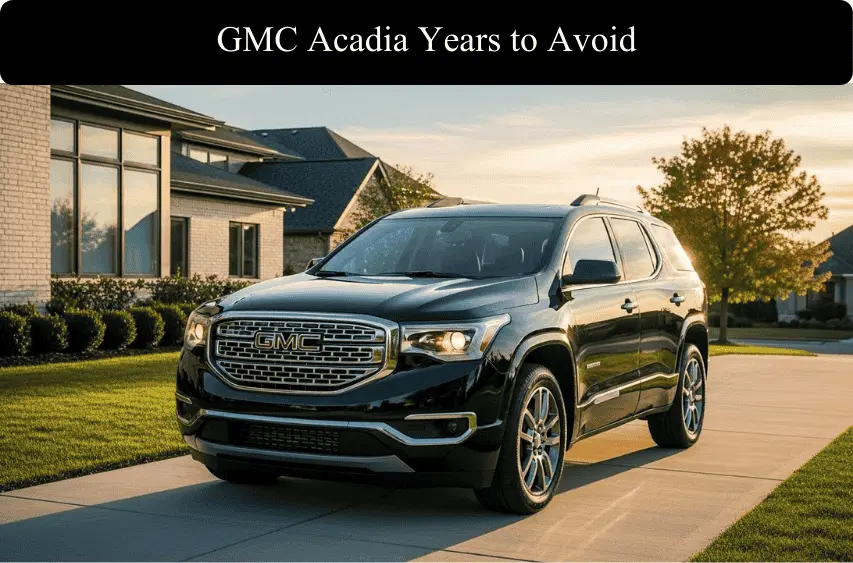
GMC Acadia Years to Avoid: A Comprehensive Reliability Guide
Families often flock to the GMC Acadia for its spacious interior and handsome design. Since its debut, this midsize SUV has promised the perfect blend of utility and comfort, making it a common sight in school drop-off lines and weekend road trips. However, the difference between a reliable family hauler and a money pit often comes down to the specific model year you choose.
While the Acadia has enjoyed strong sales figures, its reliability history is a rollercoaster. Some model years are notorious for catastrophic mechanical failures that can leave owners stranded and facing repair bills worth thousands of dollars. Identifying these problematic years is crucial before you sign any paperwork.
This guide analyzes technical bulletins, consumer complaints, and repair data to help you navigate the used market. Our goal is to steer you away from the lemons and toward the models that offer genuine value. While the Acadia has a rugged, imposing exterior that might remind you of a car that looks like a tank, the reality is that early models lacked the mechanical durability to match their tough looks.
Quick Summary: GMC Acadia Model Years at a Glance
If you are browsing listings right now and need a fast answer, we have broken down the production run into clear categories. The sharp contrast between the “best” and “worst” years is driven by specific engineering defects that General Motors eventually corrected.
Here is your cheat sheet for the GMC Acadia:
| Category | Model Years | Primary Issues |
| Years to Avoid | 2007, 2008 | Transmission Failure (Wave Plate) |
| Years to Avoid | 2012, 2013 | Timing Chain Stretch, Engine Leaks |
| Years to Avoid | 2017 | “Shift to Park” Electrical Defect |
| Years to Buy | 2015, 2016 | Transmission Issues Resolved |
| Years to Buy | 2019–2023 | Updated Powertrain & Tech |
GMC Acadia Generations Overview
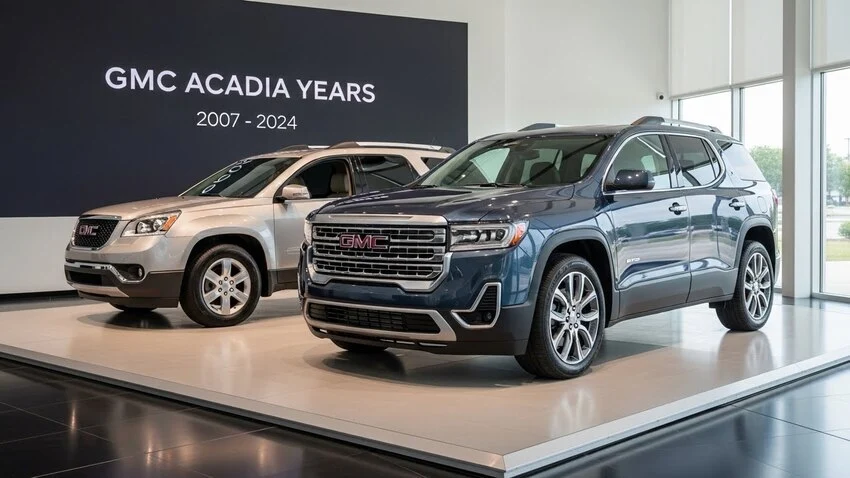
Understanding the generation of the vehicle helps you predict the type of maintenance it will need. GMC has released three distinct generations, each with its own set of pros and cons.
First Generation (2007–2016)
The original Acadia launched on GM’s “Lambda” platform. It shares its DNA with the Chevrolet Traverse and Buick Enclave. These SUVs are massive, offering cavernous cargo space and a true third row that adults can actually use. However, because this was a new platform for GM, the earliest years (2007–2008) suffered from significant “teething issues,” particularly with the transmission and power steering systems.
Second Generation (2017–2023)
For the second generation, GMC downsized the Acadia significantly. They moved it to the lighter C1XX platform to improve fuel economy and maneuverability. While these models are easier to drive in the city, they lost some cargo capacity. This era also introduced modern safety tech and a 2.0L Turbo engine option, though the launch year (2017) introduced annoying electrical gremlins.
Third Generation (2024–Present)
The latest Acadia has returned to its roots, growing larger again to compete with rivals like the Hyundai Palisade. Since these models are still new to the road, long-term reliability data is scarce, so this guide focuses primarily on the used market availability of the first two generations.
Detailed Breakdown: GMC Acadia Years to Avoid
To avoid buying a headache, you need to know exactly what goes wrong. The following model years have higher-than-average complaint rates for specific, expensive failures.
The Early Years: 2007 and 2008
Data consistently points to 2007 and 2008 as the absolute worst model years for the GMC Acadia. These vehicles are prone to transmission failure rates that are far above the industry average.
The Transmission Nightmare
The core problem lies in the 6T75 6-speed automatic transmission. Inside this unit, a component called the “35R clutch wave plate” was heat-treated improperly during manufacturing. This wave plate acts as a cushion for gear changes. In the 2007 and 2008 models, this plate is brittle and prone to shattering.
When the wave plate breaks, it sends sharp metal debris circulating through the transmission fluid. This debris destroys internal gears and pumps. Drivers often experience a sudden loss of reverse gear, or the transmission begins slipping badly in 3rd and 5th gears.
The Cost to Fix
Unfortunately, you cannot fix this with a simple software update. Repairing a shattered wave plate requires rebuilding or replacing the entire transmission. Owners often face repair bills exceeding $3,000. Considering the current resale value of a 2008 Acadia, this repair often costs more than the car is worth, making these years a risky financial gamble.
The Mid-Cycle Slump: 2012 and 2013
Just when consumers thought GMC had ironed out the early bugs, a new set of challenges emerged in the later years of the first generation. While the 2012 and 2013 models improved on the transmission front compared to their predecessors, they developed a reputation for engine vulnerabilities that can be equally costly to address.
Engine and Timing Chain Troubles
The primary culprit in this era is the 3.6L V6 engine. While this engine delivers decent power for highway merging, it has a complex timing chain system that is sensitive to oil quality. In the 2012 and 2013 model years, owners frequently reported premature timing chain stretching.
Unlike a simple belt replacement, changing the timing chains on this V6 engine is a labor-intensive job. The chains are located at the rear of the engine, often requiring the mechanic to drop the entire engine cradle out of the vehicle to access them.
The symptoms usually start with a “Check Engine” light and codes like P0008 or P0017, indicating a correlation error between the crankshaft and camshafts. If ignored, a stretched chain can skip a tooth, causing the pistons and valves to collide, which destroys the engine instantly. Regular oil changes are the best defense, but buying a used model with an unknown maintenance history carries significant risk.
A/C System Headaches
Another frustrating issue specific to the 2012 and 2013 Acadias involves the air conditioning system. Leaks often develop in the evaporator core, which is buried deep behind the dashboard. Drivers might notice the A/C blowing warm air or a strange chemical smell in the cabin. Because the entire dashboard assembly must be removed to replace the part, the labor costs alone can push the repair bill over $1,000, even if the part itself is relatively cheap.
The Redesign Stumble: 2017 and 2018
GMC completely redesigned the Acadia for the 2017 model year, making it smaller and lighter. While this improved fuel economy, the launch of the second generation introduced a new, widely reported electrical fault.
The “Shift to Park” Glitch
The most notorious problem for the 2017 and 2018 models is the “Shift to Park” error message. Owners will place the vehicle in Park and turn off the engine, but the dashboard displays a message insisting the car is not in Park.
This happens because of a tiny microswitch inside the gear shifter assembly that fails to recognize the lever’s position. Since the car believes it is still in gear, the accessory electronics stay on, draining the battery dead overnight. It forces owners to wiggle the shifter repeatedly just to get the system to shut down properly.
Driveshaft Concerns
Safety also took a hit during this redesign period. General Motors issued a recall for certain 2018 models regarding the driveshaft assembly. In some cases, the driveshaft could detach while the vehicle was in motion. This leads to a sudden loss of propulsion, which can be terrifying at highway speeds. While recalls cover the cost of repair, it is vital to verify that this work has been performed if you are looking at a 2018 model.
Common Problems Across All Model Years
Beyond the specific “bad years,” the GMC Acadia suffers from a few persistent issues that seem to crop up regardless of the generation. These are defects inherent to the vehicle’s design and weight.
Persistent Transmission Worries
While the 2007-2008 models had the exploding wave plates, transmission longevity remains a concern for high-mileage Acadias of any year. The heavy curb weight of the vehicle puts immense strain on the drivetrain. If the previous owner used the vehicle for heavy towing without installing an auxiliary cooler, the transmission fluid can degrade quickly, leading to “shuddering” between gears—usually felt most between 30 and 50 mph.
Electrical Gremlins
Modern GM vehicles are packed with technology, and the Acadia is no exception. Owners across various model years report intermittent electrical issues. Common complaints include infotainment screens that freeze or go black, backup cameras that fail to display an image, and side-detection sensors that trigger false alarms. While these are often annoyances rather than safety hazards, they can be expensive to diagnose and fix once the warranty expires.
Suspension Wear
The Acadia offers a smooth, car-like ride, but that comfort comes at a price. The suspension components, particularly the front struts and control arm bushings, tend to wear out faster than average. This is largely due to the vehicle’s substantial size and weight. Clunking noises when going over speed bumps or uneven tire wear are telltale signs that the suspension needs a refresh.
Best GMC Acadia Years to Buy
Now that we have covered the years that might drain your bank account, let’s focus on the models that deliver the reliability you expect. General Motors typically refines its vehicles over the course of a generation, meaning the last few years of a production run are often the safest bets.
The “Golden” First Generation (2015–2016)
If you love the massive size of the original Acadia, the 2015 and 2016 models are your sweet spot. By this time, GM had largely engineered out the transmission wave plate failures and timing chain issues that plagued the earlier years. These models give you the cavernous interior space of the older platform but with significantly better build quality. They represent excellent value on the used market, offering a lot of car for the money.
The Refreshed Second Generation (2019–2023)
After the stumbling start of the second generation in 2017, GMC quickly corrected course. The 2019 models and newer have far fewer complaints regarding the “Shift to Park” defect. Additionally, in 2020, GMC introduced a new 9-speed automatic transmission. This unit is smoother and more responsive than the older 6-speed, improving both the driving experience and fuel efficiency.
Competitor Comparison: Alternatives to the Acadia
The Acadia is a strong contender, but it isn’t the only option in the crowded SUV market. It helps to look at how it stacks up against some heavy hitters.
Toyota 4Runner
If your definition of “family adventure” involves off-road trails rather than paved highways, you might find the Acadia a bit too soft. The Toyota 4Runner is a body-on-frame beast designed for durability. However, it rides much rougher than the Acadia and consumes more fuel. Even with Toyota’s legendary reputation, specific years have their own issues, so be sure to check the Toyota 4Runner years to avoid to ensure you don’t buy a model prone to rust or head gasket failures.
Hyundai Santa Fe
For buyers who prefer the comfortable, car-like handling of a unibody crossover, the Hyundai Santa Fe is a direct rival to the Acadia. It often offers more standard technology features for a lower price. However, Hyundai has faced significant recalls regarding engine fires and oil consumption in recent years. Before cross-shopping, review the Hyundai Santa Fe years to avoid to make sure you are comparing the Acadia against a reliable Santa Fe model year.
Pre-Purchase Inspection Checklist
Even if you pick a “safe” model year, every used car has a unique history. Use this checklist to spot potential red flags before handing over your cash:
- Transmission Fluid Check: Pull the transmission dipstick (if equipped) or ask a mechanic to check the fluid. It should be bright red. If it smells burnt or looks dark brown, the transmission may be on its last legs.
- Listen for “The Shudder”: During your test drive, accelerate gently up to 45 mph. If you feel a vibration or shudder through the floorboard, the torque converter may be failing—a common issue on neglected Acadias.
- Scan for Silent Codes: Bring an OBDII scanner. Even if the Check Engine light is off, look for “pending” codes like P0008 or P0017. These are the early warning signs of timing chain stretch that the seller might have cleared recently.
- Check for Moisture: Lift the floor mats in the front passenger footwell. If the carpet is damp or smells musty, the sunroof drains are likely clogged, which can lead to expensive electrical corrosion.
GMC Acadia Resale Value & Depreciation
Depreciation is a double-edged sword. The unreliable reputation of the 2007–2013 models has pushed their resale value to rock bottom. While a $5,000 price tag on a 2008 Acadia looks tempting, remember that a single transmission repair could double your investment cost.
Conversely, the 2017 and newer models have followed a more standard depreciation curve. The smartest financial move is often to buy a Certified Pre-Owned (CPO) model that is 3 to 4 years old. This lets the original owner take the biggest depreciation hit while you still get a vehicle with plenty of life left and potentially some factory warranty coverage.
FAQs
The 2008 model year is widely considered the worst due to the high frequency of transmission failures and the high cost to repair them.
Yes. By the 2015 model year, the widespread wave plate failures were largely resolved, and the 9-speed transmission introduced in 2020 has proven to be reliable so far.
With strict adherence to maintenance schedules—especially oil changes to protect the timing chains—an Acadia can reach 200,000 miles. However, neglected models often fail near the 100,000-mile mark.
Conclusion
The GMC Acadia is a “tale of two cars.” The early models (2007–2008) and the transitional years (2017) serve as cautionary tales of engineering oversights. They are risky buys that can turn a bargain into a burden. However, the refined models from 2015–2016 and 2019–2023 are excellent vehicles that offer the space, comfort, and utility that modern families need. By avoiding the specific years highlighted in this guide and performing a thorough inspection, you can drive away in an Acadia that is safe, reliable, and ready for the road ahead.