When Defective Motorcycle Parts Cause High-Speed Crashes
A motorcycle operates with zero margin for error. Unlike a passenger car, which can often remain stable if a tire blows or a steering component fails, a motorcycle relies on a delicate balance of physics and mechanical integrity to stay upright. At highway speeds, the failure of a single bolt, brake line, or tire bead is a life-threatening event. When a part fails at 70 mph, the rider is effectively a passenger on a machine incapable of following their commands — and the resulting crash is often a violent, high-energy impact they have no way to avoid.
Determining fault requires moving beyond driver behavior. While officers often default to “operator error” as the cause of a single-vehicle wreck, the truth often lies in a manufacturing plant hundreds of miles away. Proving a mechanical defect caused the crash requires forensic engineering and aggressive legal discovery. If you suspect hardware failure, contacting the Gorospe Law Group is the only way to ensure the machine is properly preserved and inspected by experts who can distinguish impact damage from a pre-existing flaw.
The Critical Vulnerability of Two-Wheel Systems
In a four-wheeled vehicle, suspension and chassis offer redundancy — if one part fails, others compensate for a controlled stop. A motorcycle has no such luxury. A front fork collapse or rear swingarm failure at high speed creates an immediate, unrecoverable loss of geometry. When structural integrity is compromised by a defect, physics takes over, resulting in a tank slapper or sudden low-side crash.
Manufacturers know riders have no protective cage, which places a heightened duty of care on engineering and assembly. A defect that triggers a minor recall for a sedan can be fatal for a motorcyclist. When a manufacturer cuts corners on material quality or skips a critical QC step, they are gambling with the rider’s life.
Common Mechanical Failures Leading to Instability
The most dangerous motorcycle issues involve critical parts like tires, brakes, and drive-trains. Early failures often result from engineering or manufacturing flaws, not maintenance mistakes.
- Tire Bead Failure: A defect in the tire’s structure can cause instantaneous pressure loss. This strips the rubber from the rim, making the motorcycle impossible to steer or balance.
- Braking System Malfunctions: Flaws in the brake caliper or master cylinder can result in a total loss of stopping power or unprovoked wheel lock-up.
- Defective ABS Modules: If an anti-lock braking system module fails, it can cause the front wheel to lock at high speeds, often throwing the rider over the handlebars instantly.
- Catastrophic Drive-Train Failure: A snapped chain can wrap around the rear sprocket, while a final drive housing failure in shaft-driven bikes can seize the rear axle, locking the wheel mid-ride.
- Manufacturing vs. Maintenance: These incidents are often failures of metal and engineering. When components designed for long-term use fail early, it points to a direct defect in the product’s design or assembly.
Investigating Manufacturing vs. Maintenance Defects
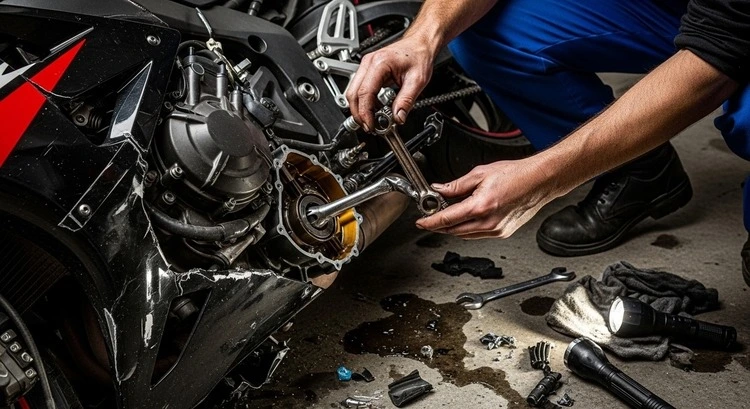
The first defense insurers and manufacturers use is blaming the rider for poor maintenance — examining tire age, chain tension, and fluid levels to claim negligence. A successful legal strategy counters this with metallurgical analysis to prove the failure was internal. Forensic engineers examine fracture surfaces to determine whether a bolt failed due to a manufacturing void or external force — the distinction that separates a winnable product liability case from a traffic accident.
Manufacturing defects occur when a specific part is built incorrectly, such as with inferior alloys or improper heat treatment. Design defects are more widespread, making every unit on the road a potential failure. Distinguishing between a one-off assembly error and a systemic design flaw determines the lawsuit’s scope and whether to pursue an individual claim or class action.
The Legal Theory of Strict Product Liability
Product liability cases don’t require proving a specific factory worker was careless. Under strict liability, the manufacturer is responsible if the product was defective and caused the injury. The question is whether it was unreasonably dangerous for its intended use. If a motorcycle marketed for highway use fails under standard highway conditions, it has failed the consumer expectations test.
Strict liability extends to the entire supply chain — designer, manufacturer, and the selling dealership. When damages exceed a single dealership’s coverage, a legal team can reach back to the parent corporation to ensure sufficient assets cover the victim’s lifelong care.
Navigating Recalls and Hidden Defects
Manufacturers often issue recalls only after regulatory pressure or high-profile fatalities. A bike without a recall may still be defective — many riders are the first to experience a failure that eventually becomes a national safety campaign. Legal teams must search NHTSA databases for similar complaints that haven’t reached the recall stage, demonstrating the manufacturer had prior notice.
When a recall has been issued, it can strengthen the case as an admission of danger — but manufacturers will argue the rider should have responded. Overcoming this requires showing the notice was never received, was confusing, or that failure occurred before the recall was announced.
Proving Causation in Crash Reconstructions
The hardest challenge is proving the part broke before the crash, not because of it. When a motorcycle hits a guardrail at 60 mph, almost everything breaks. Manufacturers claim snapped axles and cracked frames resulted from impact. To counter this, reconstructionists use digital simulations to show the bike’s trajectory changed before any external impact. Skid marks showing rear wheel lock-up while traveling straight on clear pavement indicate a mechanical seizure.
Modern motorcycles equipped with Inertial Measurement Units and Engine Control Units record lean angle, brake pressure, and wheel speed. A sudden spike in wheel speed or drop in oil pressure seconds before the crash creates a digital fingerprint of failure — far harder to dismiss than a rider’s memory. Securing this data before the bike is scrapped is the highest priority after a wreck.
Damages in Product Liability Claims
High-speed motorcycle crashes almost always produce catastrophic injuries — traumatic brain injuries, spinal cord damage, or amputations. Damages extend to 24-hour nursing care, home modifications, and total loss of future earning capacity. Manufacturers fight these cases aggressively because losses damage brand reputation and invite further litigation.
A successful claim covers economic and non-economic damages alike, including pain and suffering and the psychological trauma of a machine failure. When a manufacturer knew about the defect and ignored it, punitive damages may be awarded — the only mechanism that consistently forces corporations to prioritize rider lives over profit.